Support independent arts journalism by joining our Patreon! Currently $5/month.

About Superconductor

Our motto: "Critical thinking in the cheap seats." Unbiased, honest classical music and opera opinions, occasional obituaries and classical news reporting, since 2007. All written content © 2019 by Paul J. Pelkonen. For more about Superconductor, visit this link. For advertising rates, click this link. Follow us on Facebook.
Showing posts with label Operetta. Show all posts

Thursday, July 19, 2018

Recordings Review: A Show For Our Troubled Times

Opera Saratoga unleashes The Cradle Will Rock.
by Paul J. Pelkonen
The cast of Opera Saratoga's searing new recording of The Cradle Will Rock.
Image © Opera Saratoga and Bridge Classics.
There is no show in the history of New York theater with a more troubled history than The Cradle Will Rock. This hybrid between serious drama, operetta and musical comedy was written in 1937 by composer Marc Blitzstein, only to run smack dab into government bureaucracy, anti-Communist paranoia and union regulations that conspired to kybosh its planned first performance at the Maxine Eliot Theater. (The show had been sponsored by the Federal Theater and the Works Progress Administration, but the theater was padlocked four days before the scheduled premiere.) Mr. Blitzstein took the show, its actors and singers twenty-one blocks  uptown to the Phoenix Theater. There, he led the performances from a stage piano as actors, sitting in the house, sung out their parts on cue.

Wednesday, January 3, 2018

Opera Review: Do Not Resuscitate

The Merry Widow kicks it at the Met.
by Paul J. Pelkonen
Susan Graham is game in Act II of The Merry Widow at the Met.
Photo by Marty Sohl © 2017 The Metropolitan Opera.
When the Peter Gelb era at the Metropolitan Opera is examined in posterity, the recent renaissance of operetta on the stage of that institution may rank among the general manager's more questionable endeavors. This season, the company is reviving its 2014 staging of Franz Lehár's The Merry Widow in its awkward English translation by house scribe Jeremy Sams. The saving grace of this revival is that it is a vehicle for Susan Graham, in her only role at the Met this season.

Friday, December 8, 2017

Metropolitan Opera Preview: The Merry Widow

Susan Graham makes a welcome and timely return to the Metropolitan Opera.
by Paul J. Pelkonen
Susan Graham as Hanna Glawari in The Merry Widow.
Photo by Marty Sohl © 2017 The Metropolitan Opera.
The Metropolitan Opera invites its attendees to have themselves a very merry...widow. The generally ebullient Susan Graham makes her one return to the Met this season in the role of Hanna Glawari, the title character of Lehar's The Merry Widow.

Saturday, April 29, 2017

Opera Review: The Treasure Hunters

Manhattan School of Music unearths Die Zigeunerbaron.
by Paul J. Pelkonen
True love wins the day in the last scene if Die Zigeunerbaron.
Photo courtesy Manhattan School of Music.
Johann Strauss Jr. was the most popular composer of the Austrian Empire, and his waltzes still provide the social soundtrack of Vienna for the tourists that visit that city every year. However, with the exception of Die Fledermaus, his stage works have disappeared from the operatic repertory. This is a reflection of the general state of light opera and the changing tastes of a fickle public. The Manhattan School of Music has taken a huge step to correct this by choosing to end their spring season with Der Zigeunerbaron (”The Gypsy Baron”) an energetic operetta that is rarely seen anymore outside of a Viennese theater.

Saturday, January 14, 2017

Opera Review: The Way the Big Wheel Spins

The New York City Opera bets the farm on Candide.
The cast of Candide hoofs through "What's the Use?" in Act II of the Leonard
Bernstein comedy. Photo by Sarah Shartz © 2017 The New York City Opera.
 
In 1982, the legendary Broadway director Hal Prince mounted Leonard Bernstein’s Candide at the New York City Opera. That show did much to salvage the reputation of the composer's most problematic stage work. Candide first came to life as a Broadway musical. It bombed, was rewritten (with a new libretto) and rebuilt an operetta with slight plot differences. The Prince solution was to present a sort of hybrid, a revised, two-act comedy that filtered Voltaire's cynicism through Bernstein's gift for a good tune supported by musical references to most of the major opera composers that had come before.

Thursday, November 26, 2015

Metropolitan Opera Preview: Die Fledermaus

The Met revives the one about the guy in the bat costume. (Not Bruce Wayne.)
by Paul J. Pelkonen
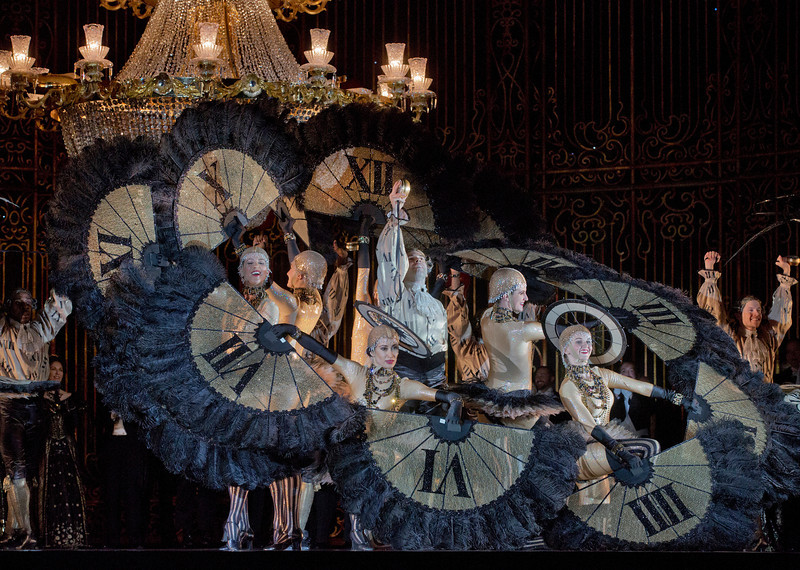
Clock's already ticking: the dancers of Die Fledermaus.
Photo by Ken Howard © 2015 The Metropolitan Opera.
The Metropolitan Opera resuscitates its 2013 production of Johann Strauss Jr.'s most popular operetta Die Fledermaus. This is the frothy Viennese comedy: the story of a guy determined to cheat on his wife, a saucy maid out to have a good time, and the Italian tenor who winds up getting (accidentally) thrown in jail. The only hitch: a lurching, unfunny English libretto, which is a step down from the German original.

Tuesday, April 28, 2015

Opera Review: The Little Kicks

The Merry Widow returns at the Met.
by Paul J. Pelkonen
Flying over Gay Paree: three Grisettes in Act III of the Met's production of The Merry Widow.
Photo by Ken Howard © 2014 The Metropolitan Opera.
The Metropolitan Opera's new production of Lehár's The Merry Widow is back on its stage. This time, it is Susan Graham, back in the title role of Hanna Glawari, the young and glamorous  Pontivedrian heiress at play in the City of Lights. This production, (which starred Renée Fleming when it bowed on New Year's Eve 2014) is the first Met show by Tony-winning director and choreographer Susan Strohman (The Producers.) Under the baton of principal conductor Fabio Luisi, Monday night's performance had considerable energy  if little poise as the orchestra bashed through the composer's catchy tunes.

Monday, December 29, 2014

Metropolitan Opera Preview: The Merry Widow

The Met warms up a new production of Lehár's operetta.
by Paul J. Pelkonen
Renée Fleming as Hanna and Nathan Gunn as Danilo in Lehár's "The Merry Widow."
Susan Stroman's new production opens on December 31, 2014.
Photo by Brigitte Lacombe © 2014 The Metropolitan Opera.
In this new production of the evergreen Lehár operetta, Renée Fleming is Hanna Glawari, a rich and glamorous widow who becomes the object of affection for every ardent young suitor in turn-of-the-century Paris. Nathan Gunn is her ardent suitor Danilo.

Tuesday, March 18, 2014

Concert Review: From Atonality to Whipped Cream

The Vienna Philharmonic bids farewell to the City of Dreams.
by Paul J. Pelkonen
Handy dandy: Diana Damrau takes over podium duties from Zubin Mehta (left) as
Vienna: City of Dreams comes to a riotous end at Carnegie Hall.
Photo by Steve J. Sherman © 2014 courtesy Carnegie Hall.
The Vienna Philharmonic drew the curtain on Carnegie Hall's three-week Vienna: City of Dreams festival with a massive Sunday night concert featuring a sweeping survey of that city's disparate musical history. Spanning from the choral music of Mozart to the 20th century experiments of Webern and Korngold, the orchestra players showed their affinity for dance music, opera, operetta, orchestral music, and even atonality in a sprawling program that at least, never proved dull. The inspired choice for leading this program: former New York Philharmonic music director Zubin Mehta, a beloved figure in this city.

Wednesday, January 1, 2014

Opera Review: Bat-man Returns

The Met waltzes in 2014 with its new Fledermaus.
by Paul J. Pelkonen
Watch this: Eisenstein (Christopher Maltman) woos Rosalinde (Susanna Philips) in Act II of Die Fledermaus.)
Photo by Ken Howard © 2013 The Metropolitan Opera.
The art of operetta came back to life last night at the Metropolitan Opera. On New Year's Eve, the company unveiled its eagerly anticipated new production of Johann Strauss' Die Fledermaus. The premiere, a glitzy gala occasion with many of the opera house's public areas roped off to accommodate A-list partygoers, proved to be an ebullient occasion, marking the return of this beloved work to the grand stage. This was a new production by Jeremy Sams, with glittering sets by Robert Jones.

Wednesday, April 11, 2012

Opera Review: The Sword's Upside-Down

The Collegiate Chorale takes on The Mikado.
by Paul Pelkonen
Amy Justman, (Peep-Bo) Kelli O'Hara (Yum-Yum) and Lauren Worsham (Pitti-Sing)
on their way home from school. Photo by Erin Baiano © 2012 The Collegiate Chorale.
Huge vases of cherry blossoms stood at either end of the Carnegie Hall stage on Tuesday night. The plain white plaster panels at the back of that famous stage were adorned with a projection of Mount Fuji. The Collegiate Chorale was in place, behind the American Symphony Orchestra.

Then came the announcement. "Ladies and gentlemen, we regret to inform you that the part of Pooh-Bah, scheduled to be sung by Jonathan Freeman, will be sung by Jonathan Freeman."

This bit of wit was the perfect introduction to Tuesday's endearing, if sometimes sloppy performance of Gilbert and Sullivan's Mikado, the witty work that skewered Victorian British society by moving it to the absurdly named Town of Titipu in W.S. Gilbert's version of Japan.

Under the direction of Ted Sperling, both Chorale and Orchestra delivered a fizzy account of the overture and first scene. Mr. Sperling chose fast tempos, driving the famous themes forward. This set up the entrance of Nanki-Poo (South Pacific star Jason Danielly.) He emerged, instrument in hand from the brass section. But instead of the usual Japanese shamisen, Mr. Danielly carried the instrument from the libretto, a serviceable second trombone.

He was soon joined by a trio of fine comic baritones, well known on Broadway. Mr. Freeman (Roger Debris in The Producers)  as Pooh-Bah, Steve Rosen (Spamalot) as Pish-Tush and the energetic, loose comic Christopher Fitzgerald (Wicked) as Ko-Ko, the Lord High Executioner. In a loose black hipster suit, an enormous, shabby top hat and an (upside-down) katana, Mr. Fitzgerald cut a memorable figure as the former cheap tailor. More importantly, his comic energy drove the show, even if he occsionally flubbed a line.

In W.S. Gilbert's libretto, the Three Little Maids enter late in the first act. Here, they fared better than the men. Kelli O'Hara (also a star of South Pacific) was a strong Yum-Yum, bringing warmth and self-regard to "The Sun Whose Rays." City Opera veteran Lauren Worsham was even better as Pitti-Sing, stealing hearts with a flash of an eye and a whistling air. Amy Justman had less to do as Peep-Bo, but brought able support.

Katisha's entrance is always a brilliant piece of theater: Sir Arthur Sullivan's parody of several Wagner heroines (Brunnhilde, Kundry, Isolde) all at once. Victoria Clark brought the requisite voice, a full-powered dramatic soprano and stage presence to Nanki-Poo's would-be fiancée. She threw herself into the part of the vengeance-seeking diva, at one point decking Mr. Fitzgerald during "There is Beauty in the Bellow of the Blast." To his credit, he got up, recovered, and they finished the merry duet. 

The last character to enter in The Mikado is the title character, given the appropriate pomp and circumstance with a genuine Japanese chorus accompanying his procession. Chuck Cooper was comic and magesterial, evoking a psychotic glee in "A more humane Mikado" and letting out a giggle of pleasure as he listed both crimes and punishments. The finale proceeded smoothly, whipped up to a bubbling frenzy as the world of topsy-turvy righted itself and all was well in the Town of Titipu.

Thursday, February 10, 2011

Movie Review: Topsy-Turvy

Jim Broadbent as W. S. Gilbert in Topsy-Turvy. © 1999 USA Films

Mike Leigh's affectionate, (mostly) factual and painstakingly detailed account of the partnership of William Schwenck Gilbert and Sir Arthur Sullivan--and the near dissolution of their partnership before writing The Mikado--might be the greatest backstage opera movie in recent memory. And it's being released on March 29 as part of the Criterion Collecton.

The film is set in 1884. Gilbert & Sullivan were coming off Princess Ida, a box-office bomb. Sullivan, newly knighted, was itching to write "serious" music. Gilbert was working on a new story idea, involving a magic lozenge--which Sullivan wanted nothing to do with. At a creative impasse, Gilbert hit upon the idea of setting an English farce in far-away Japan. The result: The Mikado.

Mr. Leigh's film takes you inside the world of these two creative geniuses, thanks to tour de force performances by Jim Broadbent and Alan Corduner as the librettist and composer, respectively. Mr. Broadbent plays Gilbert as a curmudgeon--the funniest man in England who can amuse the masses but barely cracks a smile. He is an irascible jerk, cold and distant to his wife, and absolute hell on his actors.
Allan Corduner as Sir Arthur Sullivan in Topsy-Turvy. © 1999 USA Films
Mr. Corduner does not pull punches with the portrayal of Sir Arthur. The composer is a drug-addicted mess who goes whoring in Paris and can barely get out of bed to conduct the Ida premiere. But the depravities of both men are redeemed by their respective creative genius, and the sheer alchemy that results when they put their minds together on a project.

And what alchemy it is. The core of Topsy-Turvy is a cracking series of lovingly staged excerpts from The Mikado, The Sorceror and Princess Ida, showcasing the multi-talented cast of singig actors--who all did their own work. Timothy Spall is memorable as Richard Temple, the bass whose booming "Mikado" aria nearly meets Gilbert's snicker-snee. Martin Savage is sufficiently decayed as the opium-addicted George Grossmith who originated the role of Ko-Ko. The supporting cast includes brief (but brilliant turns from Andy Serkis, Dexter Fletcher and

The female leads are strong as well. Shirley Henderson, (Leonora Braham/Yum-Yum) Dorothy Atkinson (Jessie Bond/Pitti-Sing) and Lesley Manville (Mrs. Gilbert) are all appealing. The elegant Eleanor David plays singer Fanny Ronalds: Sullivan's mistress. A scene where she and the composer duet on his song "The Lost Chord" at a recital provides the most sublime moment of the early going, while Ms. Henderson's verion of "The Sun Whose Rays" ends the film on a perfect, wistful note.

Thursday, January 27, 2011

Concert Review: Knickerbocker is a Slam Dunk

Broadway stars light up a Kurt Weill rarity.
by Paul J. Pelkonen
The Arrival of Peter Stuyvesant at New Amsterdam. 
From Our Country by Benson J. Lossing. Pub. Johnson & Bailey, © 1895.
As the snow battered New York on Wednesday night, the Collegiate Chorale warmed Alice Tully Hall with the second of two performances of Kurt Weill's 1938 musical, Knickerbocker Holiday.

Trending on Superconductor

Translate

Share My Blog!

Share |

Critical Thinking in the Cheap Seats