Support independent arts journalism by joining our Patreon! Currently $5/month.

About Superconductor

Our motto: "Critical thinking in the cheap seats." Unbiased, honest classical music and opera opinions, occasional obituaries and classical news reporting, since 2007. All written content © 2019 by Paul J. Pelkonen. For more about Superconductor, visit this link. For advertising rates, click this link. Follow us on Facebook.
Showing posts with label Jean Sibelius. Show all posts

Sunday, October 14, 2018

Concert Review: Rising in the East (but not too early)

A morning matinée at the New York Philharmonic.
by Paul J. Pelkonen
A man and a water tower: David Robertson returned to New York this week.
Photo by Chris Lee © 2018 The New York Philharmonic.
One could not help but notice, walking into David Geffen Hall on Friday afternoon, that there were some empty seats. These were more noticeable because they had little envelopes taped to them, presumably gifts for subscribers coming to the first Friday morning program of the 2018 season. However, as this concert started with new music, the conservative types who make the biggest Philharmonic contributions were (as is their wont) late to arrive.  Here, conductor David Robertson opened with a performance of another major work by contemporary composer Louis Andriessen, the Dutch composer whose receipt of the 2016 Kravis Prize for new music has led to an in-depth Philharmonic exploration of his catalogue.

Saturday, May 5, 2018

Concert Review: Fairy Tales of New York

Manfred Honeck returns to the New York Philharmonic.
by Paul J. Pelkonen
Conductor Manfred Honeck returned to the New York Philharmonic this week.
Photo by Felix Broede for IMG Artists. 

He may forever be known as the Conductor that Got Away.

Manfred Honeck, who was narrowly beaten out by Jaap van Zweden for the job of music director of the New York Philharmonic returned to the podium of America's oldest orchestra this week. He brought an ambitious program, featuring two of his own arrangements of orchestral music by Dvorak and Tchaikovsky, each drawn from fairy tale works by those great Romantic composers, and the evergreen Sibelius Violin Concerto as an ample and satisfying makeweight.

Saturday, October 8, 2016

Concert Review: Smashing Glass

Gemma New sparkles at the New Jersey Symphony Orchestra.
by Paul J. Pelkonen
Meet the New boss: Gemma New conducted at NJPAC on Thursday.
Photo by Fred Stucker © 2016 IMG Artists.
For centuries, the podium in front of a symphony orchestra has been a place reserved for men. However, this year the New Jersey Symphony Orchestra turned the role of music director over to a woman for the first time, appointing Xien Zhang to the post. On Thursday afternoon at NJPAC, the orchestra was led by yet another female conductor: New Zealand-born Gemma New. The one-time associate for Ms. Zhang's predecessor Jacques Lacombe, she currently leads the Hamilton Philharmonic Orchestra and is resident conductor at the St. Louis Symphony. She is at the vanguard of female conductors eager to step out of the shadows and onto a podium.

Monday, March 21, 2016

Concert Review: It's A Show About Nothing

Sibelius, Shostakovich and Salonen at the Philharmonic.
by Paul J. Pelkonen
Leonidas Kavakos (left) in a battle of wills with Alan Gilbert (right)
as the New York Philharmonic plays on behind them.
Photo by Chris Lee © 2016 The New York Philharmonic.
Alan Gilbert is back at the helm of the New York Philharmonic this week. This concert program was something of a watershed for the orchestra's music director, who has grappled with "lame duck" status since it was announced (one year ago) that he would step down at the end of next season. This week's concert program juxtaposed a post-Romantic favorite alongside a Russian rarity and Karawane, a new work by current Philharmonic composer-in-residence Esa-Pekka Salonen.

Thursday, October 15, 2015

Concert Review: Of Trolls, Swans and Indeterminate Obstacles

The Philadelphia Orchestra returns to Carnegie Hall.
by Paul J. Pelkonen
That's right! Yannick Nézet-Séguin.
Photo © 2015 by Chris Lee.
This was a concert that almost didn't happen.

On Monday night, the Philadelphia Orchestra agreed to a new one-year contract for its musicians, just one night before they were scheduled to play their first concert of the 2015 season at Carnegie Hall. With a 3% pay raise on the books and light at the end of a decade marked by bankruptcy and labor disputes, the ensemble arrived at Carnegie Hall on Tuesday, to offer a refreshing if old-fashioned program of Grieg, Bartók and Sibelius under music director Yannick Nézet-Séguin.

Thursday, February 12, 2015

Concert Review: The Ghost of Conductors Past

The Danish National Symphony Orchestra plays Carnegie Hall.
by Paul J. Pelkonen
The conductor Cristian Măcelaru made his Carnegie Hall debut Wednesday night.
Photo by David Swanson for Primo Artists Management.
Wednesday night's concert by the Danish National Symphony Orchestra was more than just a opportunity to hear this fine Copenhagen-based ensemble play the music of Carl Nielsen and Jean Sibelius. It became a tribute to the orchestra's late music director Rafael Frühbeck de Burgos, who died last summer. His substitute was Romanian conductor Cristian Măcelaru, an enthusiastic member of the new generation of maestros making his Carnegie Hall debut.

Wednesday, January 15, 2014

The Ice Breaks in Minnesota

The 15-month Minnesota Orchestra lockout is over.
by Paul J. Pelkonen

In a story that broke yesterday, the Minnesota Orchestra has ended its long lockout, putting to rest a labor dispute that turned into a Pyrrhic battle between musicians and management. The battle had a number of casualties, including the orchestra's music director Osmo Vänskä and 17 musicians who left the Twin Cities to play in other orchestras.

Friday, May 3, 2013

Minnesota Orchestra Lockout Goes "Fargo"


Music Director Ösmo Vänskä threatens to walk.
by Paul J. Pelkonen
"Whaddya mean we're not going to New York?" Steve Buscemi as Carl Showalter in Fargo.
Image © 1996 MGM.
The overwhelming silence that has settled over the Minnesota Orchestra, locked out since September, broke earlier this week, as music director Ösmo Vänskä threatened to resign.

Thursday, October 20, 2011

Concert Review: Flying the Blue Cross

LSO presents Sibelius at Avery Fisher Hall. 
Sir Colin Davis. Photo by Stephanie Berger © London Symphony Orchestra.
On Wednesday night, the London Symphony Orchestra opened their three-night stand at Lincoln Center  with a performance of two Sibelius favorites under the baton of Sir Colin Davis. The Finnish composer has always been one of this conductor's specialties, and Sir Colin has now recorded his seven symphonies twice over--once in Boston for Philips, and once on the LSO's LSO Live label.

Sir Colin is now 84, and moves slowly through the musicians to the adjustable chair on the podium. He conducts the orchestra (of which he remains president) sitting down. But this performance, of the Violin Concerto with Nicolaj Znaider and the Symphony No. 2 made the Avery Fisher Hall crowd stand up and cheer the British band as they played these quintessential Finnish works.

This Violin Concerto is a popular one, one that makes the soloist work on equal terms with orchestra and conductor. It stands at the transitory point between Sibelius' early nationalist works and the pure music that followed. The solo part is written in total cooperation with the orchestra, with the lengthy cadenzas acting as dramatic soliloquies.

Mr. Znaider launched the concerto, then wove a detailed narrative with Mr. Davis. The LSO provided robust support as the violinist weaved in and out of the melodic lines, occasionally pausing so Mr. Znaider could fire off a dazzling cadenza before diving back into the distinctive dotted  rhythm.
The second movement featured a darker, sweeter tone from Mr. Znaider,  through its slow passages, giving way to a warm, burnished sound. The finale whirled at the listener in mad dance over a jogging rhythm that sounded like a very fast Finnish polka. The violinist then asked the audience for the indulgence of an encore, dedicated to Sir Colin Davis. He played the Sarabande from Bach's Second Partita for Solo Violin.

The patriotic Second Symphony remains the most popular of the composer's seven. Sibelius, writing in Romantic and patriotic mode, used the Finnish struggle against Russian rule to paint an aural picture of victory over repression. The woodwinds played with great eloquence in the folk-dancing opening theme, answered by the brass and eventually repeated by the whole orchestra. 

Sir Colin brought grim purpose to the two central movements which depict the preparations for war. The wind solo in the Scherzo was particularly eloquent. The finale became a mighty song of triumph , roaring forth the anticipated Finnish victory over Russia, but also symbolizing man's achievements in the face of any obstacle.

Saturday, October 8, 2011

CD Review: Sibelius, Distilled

The Second, Fifth Symphonies in piano transcription.
Flying Finn: pianist Henri Sigfridsson.
Photo by Marco Borggreve. © 2011 Henri Sigfridsson/Ondine Classics.
The difficult art of turning a full orchestral symphony into a bravura work for solo piano is most often associated with the composer-pianist Franz Liszt, who transcribed the nine Beethoven symphonies into finger-busting exercises in order to please his public and publishers.

On this new disc, pianist Henri Sigfridsson chose two of Sibelius' seven symphonies: the Second and the Fifth. In the case of each work, the results make for compelling listening. This is the Finnish pianist's second disc of piano transcriptions of Sibelius works. (An earlier release on Hanssler Classics features some of the composer's tone poems and incidental music.)


Hearing a symphonic score rebuilt for the piano often allows the listener to experience fresh details of tone and color that may be obscured by the wash of strings or the stentorian force of brass. For Sibelius, whose compositional style is focused on simplicity and clarity, the transcription process sharpens each musical idea to a diamond edge.

In the case of the Second, (one of Sibelius' more optimistic symphonies) the whole first movement is built around a stuttering figure in the left hand and an answering folk-dance played with the right. The naturalistic rhythms of the symphony spring to life across the piano keyboard, as Mr. Sigfridsson plays the transcription with taut rhythms and attention to the key details in the score.

The middle movements of this symphony detail Finland's struggle for independence. Mr. Sigfridsson plays the halting cello figures of the slow movement with his left hand, interjecting alarums with his right as the Russian armies approach. The optimistic 14-minute finale is the most difficult to bring off, but this skilled piansit makes it work.

The Fifth Symphony is even more interesting, with the famous "ringing horns" of the last movement sounding forth in the bass notes of the piano, held down with careful use of the sustain pedal to recreate the original, antiphonal effect. Mr. Sigfridsson's transcription addsa uniform, almost Bach-like effect, as the noble themes sound forth.

These Sibelius transcriptions exhibit a very different style than the flashy concert works of the 19th century. Great attention is paid to inflection of the notes, to replicate a wind instrument, a rampart of brass, or a conductor siezed in the orgiastic waves of sound used to depict the rising Finnish people or the frozen tundras of Lapland. The result is wonderfully refreshing to the ears: great music stripped down to its barest essence.

Friday, October 7, 2011

Concert Review: Pinch Hitter Enters Starting Lineup

BSO's Sean Newhouse presents first program at Symphony Hall.
Sean Newhouse leading the Boston Symphony Orchestra.
Photo by Michael J. Lutch © 2011 Boston Symphony Orchestra
The Boston Symphony Orchestra's second program of its 2011 season features conductor Sean Newhouse. This budding American conductor made a splash last February, subbing for an ailing James Levine, conducting a superb Mahler Ninth on two hours' notice. But with Mr. Levine now gone from Boston, Mr. Newhouse (who holds the post of assistant conductor at the BSO) had the opportunity to conduct his first subscription concert at Symphony Hall.

This proved to be a strong evening of orchestral war-horses, led with energy and style. The concert opened with Benjamin Britten's Four Sea Interludes from the opera Peter Grimes--a work originally commissioned in 1946 by Serge Koussevitzky, himself a former BSO music director. Mr. Newhouse offered smooth string tones, a brassy sunrise in Dawn and an idyllic picture of Britten's fishing village in Sunday Morning, complete with gossiping woodwinds.

The idyll yielded to the deceptive calm of Moonlight, which pictures the fisherman Grimes on the edge of panic, literally teetering on the edge of a cliff. The opera's raw emotions burst out in the final, furious Storm, led with great emotion and simultaneous restraint by Mr. Newhouse. The work ended with a moving orchestral elegy for Britten's doomed hero, a sympathetic epitaph for the unsympathetic Grimes.

Serge Prokofiev's Third Piano Concerto is the most popular of the composer's five, an ideal showpiece for the right soloist. Here, it was French pianist Jean-Efflam Bavouzet. Mr. Bavouzet played the three movements with the right blend of ironic detachment and virtuoso technique. This concerto features some of Prokofiev's most challenging piano figures, driven with folk-like melodies that twist and turn, as the soloist dazzles the listener with raw technique.

In addition to impressive gymnastics (crossing hands in what pianists call the "pretzel trick") Mr. Bavouzet played with an elegant, liquid tone, creating legato transitions not often heard in most interpretations of this composer. The cadenzas were delicately played, with each note precisely in place and the whole flowing smoothly. Mr. Newhouse proved a strong accompanist, handling one tiny orchestral hiccough without missing another beat.

Mr. Newhouse returned to center stage for the Second (and most popular) Symphony of Finnish composer Jean Sibelius. The product of strife and the 20-year struggle for that country's independence, the Second depicts conflict between Finland and neighboring Russia. The first movement depicts the idyllic Finland with the threat of war on the horizon. BSO assistant principal oboist Keisuke Wakao led off the folksy opening figure, answered by chugging strings and a majestic brass chorale.

With its plucked opening, the slow movement is all dread and suspense. Mr. Newhouse led this tricky, episodic Andante with care, creating the aural images of a Russian army on the march and its impending crack-down on the smaller country's dreams of independence. The third movement shows the Finns preparing for war, stocking up supplies and hunkering down as the conflict erupts. It was briskly played, with an elegaic second theme in the bassoons.

Sibelius ended this symphony on an optimistic note with a rising, surging theme led by the brass section that depicts (eventual) victory over the Russians. Mr. Newhouse responded to the material, riding the waves of brass and strings to lift the last pages of this mighty finale into a joyful union with the opening wind oboe theme. This was a statement concert from an important young conductor, whose arrival in Boston may be a key part of James Levine's lasting legacy to the BSO.

Tuesday, May 17, 2011

Rare Orchestra Announces Rare U.S. Tour

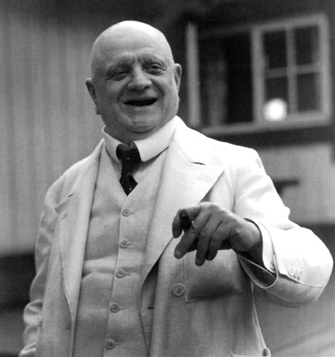
Jean Sibelius, surprised as anyone else
 that they've found the score of his Eighth Symphony.
Inspired by Daniel J. Wakin's excellent article in the New York Times on questionable orchestras and their planned tours of North America, Superconductor is pleased to announce its sponsorship of the first North American tour by the world-famous Olematon Akatemia Sinfoniaorkestri.

The group will be touring under the direction of its current music director, Lupää Johtaja. Mr. Johtaja has worked with the 120-piece touring ensemble since 1999, and originally joined the orchestra as a second triangle player.

The company's summer repertory includes Bruckner's Concerto for Two Wagner Tubas and String Orchestra, The Asteroids, a tone poem by Gustav Holst, Franz Liszt's Fourth Piano Concerto for the Left Pinkie and the Richard Strauss waltz Schlagobers. The orchestra will also be playing an abbreviated version of John Cage's 4'33" as its nightly encore.

Based in the world-class Kusta Lumi Concert Hall, newly built on the outskirts of Kemijärvi, Finland, this  ensemble is particularly revered for its performance of the recently discovered Eighth Symphony of Finnish national composer Jean Sibelius. The score, long thought destroyed, was found underneath a FinnBot pinball machine in a public house on the outskirts of Rovaniemi. A recording is forthcoming on Teldec Records.

Founded on February 30, 1973, the Olematon Akatemia Sinfoniaorkestri is an internationally accredited ensemble, which spent most of the 1970s and '80s on goodwill tours of the eastern end of the former Soviet bloc. Their first music director was the much-loved Sonni "Paska" Valehtelija. In addition to his chamber arrangement of Arnold Schoenberg's cantata Gurre-Lieder, Mr. Valehtelija was known for conducting concert versions of rare operas, including Richard Wagner's Wieland der Schmied, Giuseppe Verdi's Re Lear and Leos Janacek's The Cunning Little Agent, a dark comedy which is the flip side to the composer's The Makropolous Case.

Tour stops include Bodie, CA, Berlin, NV, Medicine Mound, TX, and Centralia, PA before returning to Europe to play a summer festival in Belchite, Spain. More information about this orchestra can be found at this site.


Sunday, April 17, 2011

Classical Music Goes to the Movies...Again

(or..."Hey, isn't that Sibelius?")

Classical music has been a big part of film ever since the early days of silent movies played to piano accompaniment. But works by the great masters show up in some pretty unexpected places. Here's a quick look at some (less than) famous appearances of the great composers' works in Hollywood.
On the run, with a cello. James Bond (Timothy Dalton)
and Kara Milovy (Maryam D'Abo) in The Living Daylights. 
© 1987 EON Productions/MGM-United Artists/Danjaq S.A.
The Living Daylights (1987)
Timothy Dalton's first Bond film was John Barry's las, and the late great British soundtrack composer loaded it with classical music. There's excerpts from Act II of Le Nozze di Figaro, the andante from Borodin's String Quartet No. 2, and the finale of Dvorak's Cello Concerto. Small wonder: the "Bond girl" in Daylights is a Czech cellist played by Maryam D'Abo.

The movie's most memorable music-related image: Dalton and D'Abo escaping into Austria...riding on a speeding cello case.

Die Hard 2 (1990)
Michael Kamen's score for the first Die Hard movie made extensive use of Beethoven's Ninth Symphony to accompany its tale of a lone-wolf cop (Bruce Willis) trapped by terrorists in an L.A. skyscraper. The sequel (yes it's also known as "Die Harder") was directed by Finnish filmmaker Renny Harlin.
"Whaddya mean there's no Beethoven in this one?" Bruce Willis in Die Hard 2.
© 1990 20th Century Fox/Silver Pictures
Like the first, Die Harder is set at Christmas. Our hero is at Dulles Airport, during a snow storm, when it gets taken over by (you guessed it) terrorists. Inspired by the winter setting (and possibly the Finnish director) Kamen chose to make Finlandia, the nine-minute tone poem by Jean Sibelius, the heart of the soundtrack. The ominous opening chords accompany the terrorist takeover, while the triumphant final march section bursts forth as Bruce Willis (once again) saves the day.


Anaconda (1997)
Verdi's least popular, least-performed opera, Alzira, is set in South America. But that didn't stop the makers of Anaconda from using the opera composer's music in their film about hapless explorers and one very big, very hungry computer-generated snake.

As their boat chugs up the river, one of the characters blasts ""Dio Che Nell'alma Infondere", the friendship duet that comes early in Don Carlo. It's the Metropolitan Opera recording with Michael Sylvester as the Don and Vladimir Chernov as the Marquis de Posa. The giant snake doesn't attack during this scene. Guess it liked opera.


The fountain scene from Ocean's 11. © 2001 Warner Brothers Pictures.
Ocean's 11 (2001)
This star-studded remake of the classic Vegas heist flick makes extensive use of Debussy's Clair de lune from the Suite Bergamesque. It first appears on the soundtrack in a modified electronic version when Tess Ocean (Julia Roberts) makes her entrance, and represents her character throughout the movie.

Later, you hear Eugene Ormandy conducting the Philadelphia Orchestra in the orchestral version of the piece, as the gang celebrates a successful triple casino robbery by standing and contemplating the fountains in front of the Bellagio. If this seems familiar it is: director Steven Soderbergh included the scene as an homage to the ending of The Right Stuff.

xXx
 (
2002)
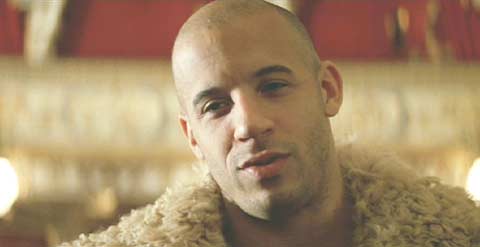
Vin Diesel's hyperkinetic take on spy movies and extreme sports culture features live performances by German metal band Rammstein and the British electronica duo Orbital. But when he's brought in for a briefing with the "M"-like Augustus Gibbons (Samuel L. Jackson) you hear...Mozart?
"Oh you've gotta be kidding me." Vin Diesel as Xander Cage (Agent XXX) in xXx.
Frame capture from xXx, © 2002 Revolution Studios.
Gibbons conducts his briefing in a Prague opera house, where he's enjoying a dress rehearsal of Don Giovanni. (Never mind that these two guys are talking through the first act.) Vin's response to this cultural exposure? The famous "Oh, you've gotta be kidding me."

Wednesday, February 23, 2011

Growing Up With Sibelius

My father was the son of Finnish immigrants. So I grew up with the music of Jean Sibelius. Finlandia, the Valse Triste, the Second Symphony were in regular rotation in our apartment, an old-style high-ceilinged Finnish co-op in the Sunset Park neighborhood of Brooklyn, NY. Today, I live in another apartment in the same building.
100 Finnish Marks, with Jean Sibelius on the bill.
These bills are no longer in circulation, since Finland uses the Euro.
It's hard to explain what Finlandia means to me--and still does. I've never been to Finland, much less Karelia where my family comes from. But this is ten minutes of music that "feels" like my national identity: the stern opening, the sturdy march, the tender, haunting center section, and the wild frenzy of brass and percussion that brings the whole thing home.

Finlandia played an important role in my birth. The "B" melody was the alma mater of the Brooklyn high school where my parents taught, met and married. And when I went with my buddies to see the Bruce Willis action flick Die Hard 2, the presence of the work on the movie soundtrack (orchestrated and arranged by Michael Kamen) had me ignoring the crashed airplanes, machine-gun battles and wisecracks of the film. (The director, Renny Harlin, is another Finn.)

Sibelius is the most famous composer to come from Finland. His music was heavily influenced by the folklore of that country, the epic poem Kalevala, and the snow-swept pine forests and frozen lakes of this northeast corner of Europe. Most importantly, his works, (particularly the tone poem Finlandia, became the soundtrack of Finnish national identity and independence from Russian rule, achieved in 1917.

As I grew up and found myself working in the music industry, I came to learn and love not just those childhood tone poems, but the major works of this great composer. His output is centered around eight symphonies: the "song symphony" Kullervo and seven numbered examples of the genre. Each of the seven is an exercise in brevity, from the patriotic early symponies, to the tight-lipped Fourth, to his Seventh, which packs an entire four-movement sonata form into about 17 minutes with each movement flowing into one another like fast-running water.
Sibelius in later life.

I started today with the juxtaposition of the Fourth and Fifth, two very different works. For the record, I was listening to the Paavo Berglund recordings on EMI with the Helsinki Symphony Orchestra, though I also own good cycles from Sir Colin Davis (with the Boston Symphony Orchestra--currently out of print) and the Philharmonia Orchestra conducted by Vladmir Ashkenazy. The Fourth (as I mentioned above) is a dark, cynical exercise in tragedy, where themes are expressed, developed, and then curtly cut off in mid-expression, like a blooming flower snipped at the stem.

The Fifth is a much warmer piece, rich and expansive. The final movement, where a stately, down-shifting theme on the horns plays as accompaniment to an elegaic outburst in the strings, stands as the most beautiful, most noble thing ever written by this composer--and that includes the second theme in Finlandia.

A statue in honor of Sibelius, part of the
Sibelius Monument in Helsinki.
Sibelius stopped composing in 1926, (my Dad was three years old) following the premiere of his tone poem Tapiola and incidental music for Shakespeare's The Tempest. He lived for another three decades. His music, championed by conductors like Eugene Ormandy and Serge Koussevitzky, remained a popular staple of concert repertory in the United States, even though his work was savaged by German and British critics. Then again, Sibelius once said:

"Pay no attention to what the critics say. Remember, there has never been a statue raised in the honor of a critic."

Alex Ross' excellent book The Rest Is Noise has a terrific chapter on Sibelius. Mr. Ross mentions that the composer was working on an expansive Eighth Symphony, which he planned as a choral work along the same lines as Beethoven's Ninth or Mahler's Resurrection. The composer decided one morning to burn the score, along with a number of other musical manuscripts. His decision was our irreplaceable loss.

Trending on Superconductor

Translate

Share My Blog!

Share |

Critical Thinking in the Cheap Seats