Support independent arts journalism by joining our Patreon! Currently $5/month.

About Superconductor

Our motto: "Critical thinking in the cheap seats." Unbiased, honest classical music and opera opinions, occasional obituaries and classical news reporting, since 2007. All written content © 2019 by Paul J. Pelkonen. For more about Superconductor, visit this link. For advertising rates, click this link. Follow us on Facebook.

Wednesday, August 3, 2011

Manahan Overboard!

City Opera Drops Music Director.
Former City Opera music director George Manahan.
Photo by Nan Melville courtesy Columbia Artists Management (CAMI)
The New York City Opera has announced that music director George Manahan will not be returning for its 2012 season. No replacement has been named.

The move marks the latest of many radical changes for this troubled opera company. In April of this year, City Opera left its longtime home at Lincoln Center, after claiming that its diminished endowment would not be enough to pay the rent on the building. The decision has led to uproar in the opera world, including a letter of protest signed by director Hal Prince and tenor Placído Domingo.

Now they'll attempt to survive without a music director, one of the key positions in any opera company. In addition to leading performances, an MD plays a key role in finding singers, administration, and overseeing all aspects of opera performance. This is the same role enjoyed by James Levine at the Metropolitan Opera.

In an interview with the New York Times, City Opera general manager George Steel said: "Given the size the company is now, it doesn't make sense for us to have a music director."


A graduate from Manhattan School of Music, George Manahan served as the music director of City Opera since 1996. During that time, the conductor led a wide range of operas, from the baroque music of Handel to modern compositions. He was a key fixture of the company for the last decade, and a steady hand on the tiller for this tempest-tossed opera company.

Mr. Manahan was conspicuously absent from the recent City Opera press conference at the Guggenheim, and is not scheduled to conduct any of the four operas that constitute NYCO's short season, beginning in the spring of 2012. The operas, scheduled for performance at BAM, John Jay College and El Museo del Barrio, include the New York premiere of Rufus Wainwright's first opera, Prima Donna, a Jonathan Miller staging of La Traviata, Mozart's Cosi fan tutte and Telemann's Orpheus.

New York City Opera's decision to leave Lincoln Center has been met with vehement protests from members of Local 802 (the musicians) and the American Guild of Musical Artists. Both organizations have been offered a vastly altered contract for next season, as the company moves from relying on a full-time orchestra and chorus to a series of sporadic, pick-up performances with no guarantees for singers or musicians. 

The Comprehensive Liszt

Bicentennial Brings Five Big Box Sets.
An old-school "Liszt box." This one plays a Hungarian Rhapsody.
Photo from Harp Gallery

2011 marks Franz Liszt's 200th birthday. Had the old gentleman been around for the birth, death, and (occasional, sputtering) revival of the classical music recording industry, he might have been amused to learn of the slew of boxed sets bearing his name and likeness that have issued forth this year.

Here's a quick overview, organized by weight:

Liszt: The Piano Collection 
(EMI Classics, 10 Discs)Various Artists
This is a solid reissue focusing only on Liszt works for solo piano. It features György Cziffra's energetic versions of the Hungarian Rhapsodies, paired with the ruminative Années de pèlerinage from Italian pianist Aldo Ciccolini. The late, eccentric British virtuoso John Ogdon also contributes to this fine set. Sadly, no opera transcriptions are included.

Liszt: Master and Magician: The Masterworks Collection
(Sony Classical, 25 CDs, 1 DVD). Various Artists
This box features all-star lineup of pianists (Vladimir Horowitz, Evgeny Kissin, Jorge Bolet, Van Cliburn) and conductors contribute to this stellar overview set, which digs deeply into the old Columbia Records catalogue. Newer recordings made under the Sony Classical imprint are also included, and the overall effect is a fairly comprehensive look at the long, varied career of Franz Liszt. Some interesting piano transcriptions here, with Glenn Gould's take on Beethoven's Fifth Symphony, and Schubert songs played by Mr. Kissin. Also includes the Grand Mass and a sampling of Liszt's organ music.

A Liszt Portrait (Brilliant Classics, 31 discs)
Various Artists
A respectable entry with both orchestral pieces, piano music and some choral music--but no Christus. The Brilliant set combines modern performances of good quality, some of them from orchestras and pianists that you may have never heard of, with ten discs worth of historical issues. Some interesting gems here: Maria Yudina playing a set of variations, early Evgeny Kissin performances, Alfred Brendel's Tannhäuser transcription. For the Liszt nut who already has everything else.


The Liszt Collection (Deutsche Grammophon, 34 discs)
Various Artists
Another "limited edition" from DG, this set combines some fascinating out-of-print recordings (Giuseppe Sinopoli conducting the Dresden Staatskapelle in the Faust and Dante Symphonies) with more familiar Liszt works.

The twelve symphonic poems are split between labels, with Solti (Decca) Haitink (Philips) and von Karajan (DG) all contributingto make a "greatest hits" version. Also contains complete reissues of Dietrich Fischer-Dieskau's invaluable two-disc survey of Liszt liederLazar Berman's Annees de un pelerenage and Roberto Szidon's kick-ass Hungarian Rhapsodies. A good overview with the exceptional sound quality one expects from DG. If the set had included Jorge Bolet's nine discs of Decca recordings it would be hard to beat.


Liszt: The Complete Piano Music (Hyperion, 99 Discs)
Leslie Howard, Piano.
Here it is. The heavyweight champion: Leslie Howard's exhaustive, exhausting survery of all the Liszt piano works, recorded for British label Hyperion over the last three decades, all in sparkling, absolutely perfect digital sound.

This bread-box of a set includes all the familiar works, along with the complete opera transciptions, the symphony transcriptions (Beethoven and Berlioz) and a few fascinating works that may or may not be from Liszt's pen. The decision to include multiple and alternate versions of Liszt works, makes this set an invaluable resource to the serious scholar of Liszt or piano music in general. You may not want to load all of these versions into your IPod, but their scholarly value is beyond dispute.

Retailing at over $300 (though it can be found for less with some effort) this is an investment. But is not an overstatement to call this large, handsome box (which includes a comprehensive softcover book) a veritable gold mine of musical inspiration. And a week's worth of listening if you play the whole set without a break.

Tuesday, August 2, 2011

Guess Who's Coming to Dinner?

The Strange Case of Don Giovanni.

"A work without blemish, of uninterrupted perfection."
--Søren Kierkegaard, on Don Giovanni
Il dissoluto punito. Act II of Don Giovanni. Artist unknown.
For many writers, musicians and composers of the 19th century, Mozart's opera Don Giovanni stood at the very top of the operatic pyramid. The Don was unique: a rollocking comedy with a grand, tragic ending, a love story with multiple partners where love is never requited, and a wellspring of inspiration for other composers, from Liszt and Wagner in the 19th century to Stravinsky and Richard Strauss in the 20th.

From the thunderous chords that open the overture to the amazing parade of arias, duets and ensembles that constitute the bulk of the score, Don Giovanni has never failed to draw an audience. Listeners get satisfaction from the familiar numbers, sung with melting seduction in the very best performances.

Don Giovanni has survived in the repertory better than any other Mozart opera, with the possible exception of the Marriage of Figaro. It requires two star baritones for the Don and Leporello. Some singers switch off in the roles. (Bryn Terfel recorded both parts, as well as Masetto early in his career.) A good Don must be able to run the gamut from sensual ardor to outright defiance. A great Don must be the bad guy who audiences are willing to root against, yet want to visit backstage afterwards.

Leporello is also complex, a comic foil who is the grandfather of Verdi's Rigoletto. His character moves to the fore in the second act, when he is unable (despite his best efforts) to keep his master from bringing about his own doom. He must bring off the 'Catalogue' song with humor and aplomb, and display convincing terror when the famous stone guest comes to dinner.  The touching line: "Ah padron, siam tutti morti" (delivered while hiding under the table is a marvelous moment of despair: the everyman's perspective on the supernatural events in the banquet scene.

"The three finest things God ever made are the sea, Hamlet and Don Giovanni."
--Gustave Flaubert

The Commendatore is not a very long part, but he should be a "black" bass with an authoritative physical presence and a voice that can put the fear of God into an opera house packed with atheists. Donna Anna is a tragic heroine of Greek proportions. Her scenes with Don Ottavio provide contrast and the soprano must be involved to bring them off. Also, poor, faithful Don Ottavio, who had his best aria removed from the opera at the premiere, must try hard not to be a nebbish although his character certainly is.

Donna Elvira is the mezzo role. She is a jilted ex- of the Don's who is still interested in the old rascal. Her plot function is to show up and ruin whatever seduction the Don may be attempting and then pine for him to take her up again. Masetto should be a Leporello-in-training with a burly presence and the right burst of anger. And his feckless Zerlina, who gets two of the best numbers, (she sings 'La ci darem la mano' with the Don and the great 'Batti, batti O Masetto') should be a soprano with a light comic grace who can feign innocence.

"Don Giovanni, thanks to the unfading and inexhaustible strength of Mozart's inspiration, has aged only in a merely technical respect."--Piotr Ilyich Tchaikovsky


To make all these elements work, the opera requires a conductor who knows how to balance Mozart's classical structures with the budding seeds of early Romanticism that are buried in the rich soil of the score. The ideal Don Giovanni conductor will make the heaven-rending chords resound in the statue scene, but keeep the rest of the Don's doings moving along at a steady clip.

He should instruct the woodwinds to accompany Leporello with sardonic humor, and the Don's macking on the ladies with grace and charm. The Donna Anna scenes should be conducted as pure opera seria, letting the singers' voices carry the weight of Mozart's emotional message. In short, it doesn't matter if this opera is fast (Gardiner, Östman) or slow (Furtwängler, Klemperer). In competent hands, the score of Don Giovanni always makes an impact.

Then there's that ending, where the good Don gets dragged off to the abyss by his chthonian dinner guest recals the medieval morality plays where the sinner is punished before the audience. Don Giovanni is the great morality play of the Age of Reason. Mozart and librettist Lorenzo da Ponte originally ended the opera with the dinner scene, adding an appendix ensemble (complete with a moral admonishment) to the work after the opera's premiere.

Monday, August 1, 2011

Opera Review: Jumpin' Jupiter!

Die Liebe der Danae at Bard SummerScape.
by Paul J. Pelkonen
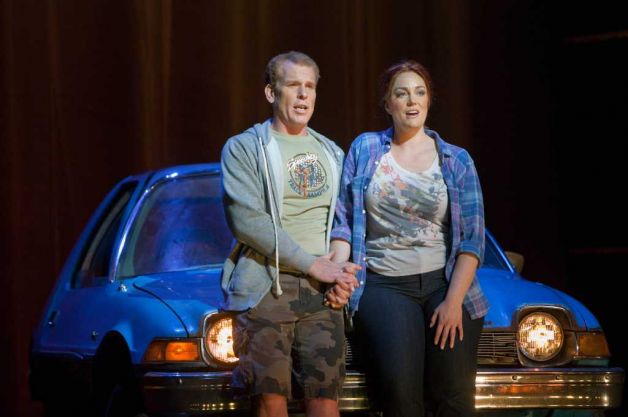
Tenor Roger Honeywell, soprano Meagan Miller and four-fendered friend.
Act III of Die Liebe der Danae at the Bard Festival. Photo by Corey Weaver © 2011 Bard Festival.
The first fully staged performances of Richard Strauss' Die Liebe der Danaë took place this weekend at the Bard Festival. Leon Botstein conducted the American Symphony Orchestra in a persuasive performance that should help restore this ignored opera to the repertory.

The demanding title role was sung by Meagan Miller, as the Greek maiden who finds herself pursued by the god Jupiter (baritone Carsten Wittmoser) and Midas, (Roger Honeywell) a donkey-driver who is Jupiter's cats-paw. In this version of myth (the libretto is by Josef Gregor) Midas gets the "golden touch" from Jupiter as a way of running interference with the god's jealous wife, Juno. But when Danae falls for Midas, the two men become rivals. Eventually, Midas and Danae are stripped of their assets. They choose a life together over Jupiter's golden temples. In a moving duet, the god reluctantly bids her farewell.

Like the other late Strauss operas, Danae is loaded with difficult vocal writing. The soprano part is both long and treacherous, all the way up to a high C-sharp at the very end. Ms. Miller, a past grand finalist at the Metropolitan Opera's vocal competitions, handled the part with power and beauty of tone. Baritone Carsten Witmoser was a moving presence as Jupiter, a high baritonal part that is a mirror of Strauss himself. Portrayed here as a money-throwing Wall Street maven à la Bernie Madoff, Mr. Wittmoser's Jupiter travels from romantic ardor to Wagnerian, godly rage, to warm resignation as he realizes that Danae really prefers Midas' hand and a life of poverty.

As Midas, tenor Roger Honeywell has a pleasing voice, but it was neither large enough or expansive enough to cope with Strauss' stentorian orchestra. Like most Strauss tenors, Mr. Honeywell did what he could with the punishing part, writing that indicated Strauss' sadistic attitude towards tenors. Although he had trouble with the extensive Act II love duet, he recovered for the last act, singing with beauty and sweetness in the duet as Midas and Danae explored their new circumstances as members of the suburban poor.

While Dr. Botstein led the New York premiere of the opera in a concert staging in Jan. 2000, (a performance recorded and released on Telarc) Danae remains one of the most obscure Strauss operas. It presents considerable challenges for the bold director willing to take it on. This smart staging by Kevin Newbury (with clever, minimal sets by Rafael Viñoly amd Mimi Lien) updated the court of King Pollux to the board-room of a Wall Street skyscraper. The choristers: suited businessmen attempting to collect debts. Danae herself is a high-fashion model, appearing in perfume ads as a kind of operatic Mary Jane Watson.

The many visual challenges (Jupiter's entry as a shower of golden rain, Danae being turned into a golden statue) were solved with wit and smart visuals. The humble third act was set in the swamps of Jersey, the sole shelter being a lone two-door hatchback (which looked like an AMC Pacer), parked in the marsh, with the towers of Manhattan far in the distance.


Strauss composed Danae in 1940, as the dark clouds of war roiled over Germany. He saw a dress rehearsal at the Salzburg Festival in 1944, but the work was never performed in his lifetime. In fact, it belongs to the beginning of the composer's late period. The score is burnished with warm chords that echo its gold-obsessed plot, lending an autumnal glow to the complex harmonies. The libretto has some unexpected twists and turns and real humor. Much of this was lent by tenor Dennis Petersen as the bankrupt King Pollux, and a fine quartet of budding divas: Aurora Sein Perry, Camille Zamora, Jamie Van Euck and Rebecca Ringle as four of Jupiter's ex-lovers.

Trending on Superconductor

Translate

Share My Blog!

Share |

Critical Thinking in the Cheap Seats