Support independent arts journalism by joining our Patreon! Currently $5/month.

About Superconductor

Our motto: "Critical thinking in the cheap seats." Unbiased, honest classical music and opera opinions, occasional obituaries and classical news reporting, since 2007. All written content © 2019 by Paul J. Pelkonen. For more about Superconductor, visit this link. For advertising rates, click this link. Follow us on Facebook.
Showing posts with label the simpsons. Show all posts

Saturday, August 23, 2014

D'oh-D'oh-D'oh-D'OHHHHH!

The Ten Best Simpsons Classical/Opera Moments
by Paul J. Pelkonen
Scratchy (left) stalks Itchy in a scene from Roger Meyers' cartoon classic Scratchtasia.
Original image from The Simpsons episode Itchy and Scratchy Land © 1994 Fox/Gracie Films
I'm in the middle of two marathons right now. One is the 2014 Superconductor Metropolitan Opera Preview, our annual look at all the opera productions that the Met is mounting next season. As I'm writing, my efforts have been accompanied by The Simpsons Every Episode Marathon. So off the top of my head, here are the greatest "serious music" moments in the show's 552 episodes. Chronological order. (I had to look up the dates--my memory is good, it's not that good.)

Tuesday, December 6, 2011

Concert Review: No Bears Allowed!

Yale musicians offer "Vocal Britain" at Zankel Hall.
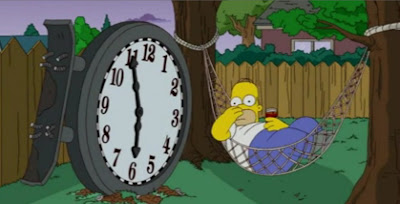
Thanks to the efficient Bear Patrol, William Walton's The Bear was not performed.
Image from The Simpsons © 1996 Gracie Films/20th Century Fox
The Yale in New York music series opened its 2011 New York season on Sunday night with Vocal Britain, a concert featuring rarities from English composers Benjamin Britten and William Walton. The program originally included The Bear, Walton's one-act opera  from 1967. The work was cancelled due to illness, and replaced with the much earlier (and more rare) Façade.

The concert opened with Song for the Lord Mayor's Table a short song cycle by Walton that incorporates medieval rhyme alongside traditional songs and poetry by William Blake. These six poems were sung with energy and clarion tone by mezzo-soprano Janna Baty. The work presented in its original version for piano and voice, with skillful accompaniment by Jill Brunelle.

Ms. Baty brought sardonic resignation to "Wapping Old Stairs," the story of a long relationship and the effect of infidelity upon the doing of laundry. A searching sense of mystery penetrated "Holy Thursday," the Blake poem. "The Contrast" explored the dichotomy of city life with vacations in the country. Ms. Baty pulled out the stops for "Rhyme." In this final poem, her voice rang out even as she evokes the ringing bells of London's church towers.

Chamber musicians from Yale took the stage for the next work, Benjamin Britten's Serenade for Tenor, Horn and Strings. William Purvis played the opening horn solo on a natural horn, and then picked up a valved instrument for the folowing songs. The work moves through a cycle of poems by Charles Cotton, Lord Tennyson, William Blake, Ben Jonson and John Keats, and ends with a final, quiet horn solo played from offstage.

The work was written as a study for Britten's opera Peter Grimes, and explores some of the same bleak emotional territory as that work. Tenor Dann Coakwell took the role of a skilled lieder interpreter, guiding the listener through the work's mood of twilight and disquieting darkness. The final horn part seemed to echo in the emotional void left by the poems, making a powerful, nihilistic statement.

Written in 1922, Façade sets the nonsense poetry of Edith Sitwell in a style that combines singing, sprechgesang and speech. It's a bastard cousin to Schoenberg's Pierrot Lunaire or Stravinsky's L'histoire de soldat, with deliberately absurd words traded back and forth between narrator John McDonough and Ms. Baty. Although the poetry proved wearing after about five selections, the skilled wind playing from the Yale musicians made this a musical journey worth taking.

Thursday, March 10, 2011

Gustav Mahler...on The Simpsons?

Homer J. Simpson, appearing soon in the Metropolitan Opera's new La Traviata.
From the 2010 episode To Surveil With Love. © 2010 Gracie Films/20th Century Fox.
So this morning I'm on Hulu, catching up on this week's new Simpsons episode, The Scorpion's Tale, where Lisa accidentally creates a new "happy pill" from the extract of a desert flower. About 12 minutes into the episode, there's a montage with all of Springfields' septue- and octogenarians romping about happily. The soundtrack: Mahler's First Symphony, first movement. Conductor and orchestra unknown.

Classical music has long played an important role in the adventures of America's favorite family. The very first episode, "Bart the Genius", featured Marge taking her family to the opera. They saw Carmen. Unaccountably, the opera was advertised asbeing sung in Russian, although the singing was in French. After Bart gave his rendition of "Toreador-o, don't spit on the floor", they left the opera house and went for hamburgers.

In Season 2 (Marge vs. Itchy and Scratchy), Bart's mother lauches a successful crusade against cartoon violence. This results in the children of Springfield going out and playing in the sunshine to the bucolic strains of Beethoven's "Pastorale" Symphony, again the first movement.

Season 15's Margical History Tour featured an entire sketch based on the play and movie Amadeus. Bart was Mozart. Lisa, a jealous, angry Salieri who decides to sabotage the first performance of Bart's opera, The Musical Fruit. The episode also featured school bully Nelson Muntz as a hopeful young composer named Beethoven:

Nelson Muntz as Beethoven in a scene from Margical History Tour. © 2004 Gracie Films/FOX.

Seasons 16's The Seven-Beer Snitch featured the opening of a brand new concert hall in Springfield, designed by architect Frank Gehry. The concert hall closed quickly after the first performance of Beethoven's Fifth Symphony (the audience left after the opening "Dah-dah-dah-DUM") and became a prison.
Bart Simpson as Wolfgang Amadeus Mozart in a scene from the Mozart and Salieri
segment of Margical History Tour. © 2004 Gracie Films/20th Century Fox.
Marge Gamer (Season 18) featured Samuel Barber's Adagio for Strings. Placìdo Domingo showed up in The Homer of Seville, (Season 19) gave Homer some career tips on singing opera, and then snapped him with a wet towel. And, the highly amusing Da Vinci Code spoof Gone Maggie Gone (Season 20) featured a choir of nuns essaying the opening bars of Carl Orff's Carmina Burana.

Although the show's episodes average 20 minutes in length, (shorter than the opening movements of most Bruckner symphonies!) it is encouraging to see that the writers on America's longest-running situation comedy keep the classical music flag flying. And who knows? Some kid watching Our Favorite Family might get into classical music and some day start a blog and call it...oh, I don't know...Ultraconductor?
...Megaconductor?
...Hyperconductor?!

Here's some music:

The Los Angeles Philharmonic plays Mahler's Symphony No. 1 "Titan". 
Gustavo Dudamel conducting. © 2010 Universal Music Group

Sunday, September 30, 2007

Placido D'OH-mingo

Placído Domingo ("P. Dingo") as
drawn by Simpsons creator Matt Groening.
Image © Fox/Gracie Films
The great tenor Placído Domingo made an unexpected television appearance Sunday night, as special guest star in "The Homer of Seville", an opera-oriented episode of The Simpsons. Tonight's episode featured Homer's short career as a star tenor. After a catastrophic injury, Homer discovers that he can sing beautifully as long as he is lying on his back.

With Mr. Burns' guidance, the big guy becomes a bona fide opera star, working his way up through Puccini's La Boheme and Rossini's Il Barbiere di Siviglia.. (He did the final scene from La Boheme and the "Lindoro" aria from Barbiere during the episode, along with a Broadway selection and The Star-Spangled Banner Midway through the second act, Señor Domingo appeared as a towel-clad version of himself, giving Homer some useful career advice.

For you Simpsons fans who read this blog (and I know you're out there) this is at least the fourth time that opera has played a heavy part in an episode.

  • In Season 17, "The Italian Bob" featured Kelsey Grammar as Sideshow Bob, attempting to murder both Krusty the Klown and Our Favorite Family during a performance of Pagliacci in Rome.

  • In Season 15, "Margical History Tour" featured Bart as the young Wolfgang Amadeus Mozart (author of the opera The Musical Fruit. Lisa is the jealous (and homicidal) Salieri and Homer takes the role of Mozart's overbearing father, Leopold.

  • Sideshow Bob attempted to kill Bart to the score of H.M.S. Pinafore in Season 5.

  • And finally, the very first episode, "Bart the Genius" has Marge taking the family out to see Carmen (in Russian, no less.)

Trending on Superconductor

Translate

Share My Blog!

Share |

Critical Thinking in the Cheap Seats