Support independent arts journalism by joining our Patreon! Currently $5/month.

About Superconductor

Our motto: "Critical thinking in the cheap seats." Unbiased, honest classical music and opera opinions, occasional obituaries and classical news reporting, since 2007. All written content © 2019 by Paul J. Pelkonen. For more about Superconductor, visit this link. For advertising rates, click this link. Follow us on Facebook.
Showing posts with label deborah voigt. Show all posts

Friday, March 7, 2014

Opera Review: The Ringer Cycle

Matthias Goerne's surprise Wozzeck at the Met.
by Paul J. Pelkonen
He knows where his towel is: Matthias Goerne in the title role of Wozzeck.
Photo by Marty Sohl © 2014 The Metropolitan Opera.
At 2:10 yesterday afternoon, the Metropolitan Opera announced that Thomas Hampson had withdrawn from Wozzeck. Mr. Hampson's substitute would not be the scheduled (and already contracted) cover, but baritone Matthias Goerne. Mr. Goerne, who has sung the title role to acclaim at other houses, was in New York to sing a lieder recital at Carnegie Hall on Wednesday night. Smoke signals went up on the Internet, and a hastily written press release was slipped into thousands of copies of Playbill.

Thursday, March 6, 2014

Soldier Dodges Bullet

Mathias Goerne steps in for Thomas Hampson in Wozzeck.
by Paul J. Pelkonen
Getting the axe: Thomas Hampson has withdrawn from tonight's Wozzeck due to illness.
Matthias Goerne will sing the title role in Berg's opera.
Photo by Cory Weaver © 2014 The Metropolitan Opera.
The Metropolitan Opera has a major casting change in tonight's first season performance of Wozzeck: the title role.

Sunday, February 23, 2014

Recordings Review: The Land of Might-Have-Been

The 1998 Lohengrin from the Metropolitan Opera.
by Paul J. Pelkonen
On the wing: Ben Heppner' makes his entrance in Act I of Lohengrin.
Photo by Marty Sohl © 1998 The Metropolitan Opera.
I don't always have time on this blog to write about opera recordings, and the huge back-log I've developed (from not having time to write recording reviews!) makes it all the more difficult. However, I wanted to take a few minutes to write up the recording I've been spending the last two days listening to: a 1998 live performance of Lohengrin from the Metropolitan Opera. The set is of interest not only for its high quality as a Wagner performance, but for its pairing of Deborah Voigt and Ben Heppner, who were the intended stars of the company's new Robert Lepage production of the Ring. (In the end, Ms. Voigt sang the performances, but Mr. Heppner withdrew the role of Siegfried from his repertory.)

Saturday, September 7, 2013

Isolde Dumps Tristan


Deborah Voight withdraws from WNO Wagner run.
by Paul J. Pelkonen
To sail no more: Deborah Voigt may have sung her last Tristan und Isolde.
Photo by Ken Howard © 2007 The Metropolitan Opera.
One week before the premiere of its new production of Tristan und Isolde, the Washington National Opera had to search for a replacement soprano.

According to a story by Anne Midgette in today's Washington Post, soprano Deborah Voigt has bowed out of the WNO's season-opening run of the Wagner opera. Ms. Midgette also reported that the soprano is considering retiring the role of Isolde (the fiery Irish princess who falls hard for a Cornish knight) from her repertory.

Sunday, May 12, 2013

Opera Review: Countdown to Extinction

The Met presents the last Götterdämmerung of 2013.
by Paul J. Pelkonen
A fine romance: Brunnhilde (Deborah Voigt) sends Siegfried (Lars Cleveman)
off to battle in the Prologue to Wagner's Götterdämmerung.
Photo © 2013 The Metropolitan Opera.
At the time of this writing, it is uncertain if Saturdays matinee performance of Götterdämmerung at the Metropolitan Opera, was the final performance ever of the company's current production of Wagner’s Der Ring des Nibelungen. If this was the last performance of Ring (which premiered with Das Rheingold in 2010) before the Met decides to cut its losses, the quality of this performance may have earned a stay of execution, if not an acquittal for this troubled show.

Tuesday, May 7, 2013

Twilight of the Machine

Robert Lepage's Ring may face the scrap heap.
by Paul J. Pelkonen
Up in flames: a scene from Act III of the Metropolitan Opera production of Götterdämmerung.
Image © 2012 The Metropolitan Opera.
According to an article published yesterday on parterre.com, this might be the end of the road for the Metropolitan Opera's current production of Wagner's Der Ring des Nibelungen. The company has one performance of Siegfried and one of Götterdämmerung scheduled for later this week.

Monday, April 22, 2013

Opera Review: We Don't Need Another Hero

Siegfried at the Metropolitan Opera.
by Paul J. Pelkonen
Stick them with the pointy end: Jay Hunter Morris stars in Siegfried.
Photo by Corey Weaver © 2013 The Metropolitan Opera.
Richard Wagner's Siegfried is the least popular chapter in the Ring cycle. Wagner thought audiences would eat up this fairy-tale story of a blond muscleman who grows up in the forest and embarks on a career as a dragon-slayer before wooing the Valkyrie maiden Brunnhilde. But he didn't put any women in the first three hours of the opera. The 11am start time at the Metropolitan Opera House might also account for the number of empty red velvet seats at Saturday's matinee performance, the first of three this season.

Monday, April 15, 2013

Opera Review: The Brother From Another Opera

Siegmund falls early; the Met revives Die Walküre.
by Paul J. Pelkonen
Wotan, (Mark Delavan) Brünnhilde (Deborah Voigt) and (at right) a plank of the "Machine."
Scene from Act II of Die Walküre. Photo by Ken Howard © 2013 The Metropolitan Opera.
There were no technical problems with Saturday morning's matinee performance of Richard Wagner's Die Walküre. In fact, the Metropolitan Opera's revival of the second chapter in Robert Lepage's production of Der Ring des Nibelungen went off without a glitch from the "Machine," the 45-ton set that occasionally upstages the gods and mortals that inhabit this mythic German drama.

On Saturday morning, the problem was...allergies.

Friday, April 5, 2013

Metropolitan Opera Preview: Die Walküre

Robert Lepage's high-flying Wagner circus continues.
Nine girls and a machine in Act III of Die Walküre.
(That's Deborah Voigt bringing up the rear.)
Photo by Ken Howard © 2010 The Metropolitan Opera.
Like every opera in Robert Lepage's version of The Ring, Die Walküre takes place on a massive unit set with 24 rotating planks above the Met stage. Over the course of four hours, the "Machine" (as stage-hands call it) transforms into mountain-tops, buildings, trees, and even a gigantic flying wing for the Ride of the Valkyries.

Friday, March 8, 2013

2013-14 Preview: Washington National Opera

Wagner and Verdi centennials at the Kennedy Center.
by Paul J. Pelkonen
Whalers vs. capital: Jake Heggie's Moby-Dick (opening Feb. 22 2014)
highlight of the upcoming WNO season at the Kennedy Center. Image © JakeHeggie.com
With the Metropolitan Opera offering a Wagner-free 2013-14 schedule, it is left to opera companies in other cities to satisfy a yearning for music drama.  The Washington National Opera has stepped up. the company announced today that its first season under the stewardship of new Artistic Director Francesca Zambello will open Sept.15 with an imported production of Tristan und Isolde.

Tuesday, December 18, 2012

Opera Review: A Horse of Different Colors

The Metropolitan Opera revives Les Troyens.
by Paul J. Pelkonen
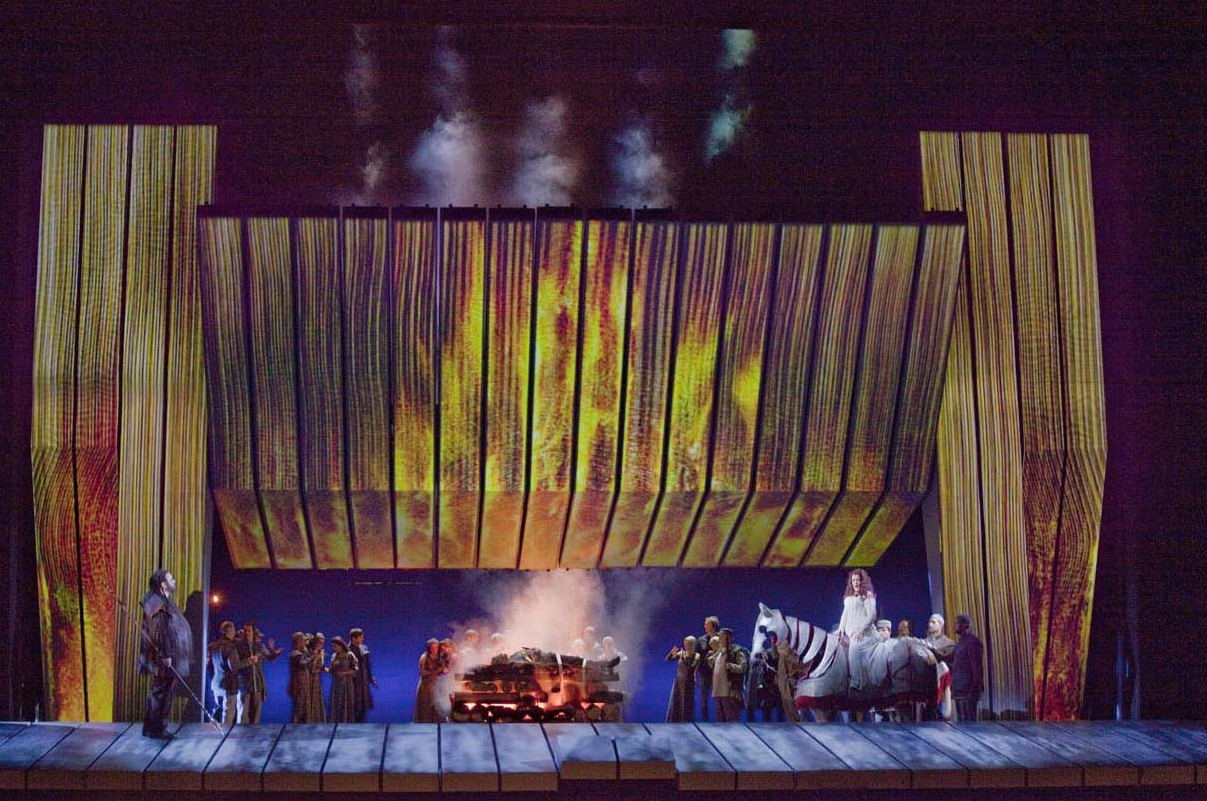
Pyre woman: Didon (Susan Graham) goes to her death in Act V of Les Troyens.
Photo by Cory Weaver © 2012 The Metropolitan Opera.
Hector Berlioz' Les Troyens is the most ambitious of 19th century French operas. Clocking in at five acts and five hours (counting intermissions) the opera has divided opinion since its premiere, when Paris' Theatre-Lyrique would only present the second half of the opera as Les Troyens à Carthage. The first half, La Prise de Troie was never performed in the composer's lifetime.

Monday, December 10, 2012

Metropolitan Opera Preview: Les Troyens

The Met brings back Berlioz' classical epic.
by Paul Pelkonen
The Trojan Horse in Act I of Les Troyens in the Met's production. That's Deborah Voigt at the left.
Photo by Marty Sohl © 2003 The Metropolitan Opera.
A snarky opera commentator might call this revival The Return of the Horse. The Met brings back Francesca Zambello's stunning production of Hector Berlioz' longest opera, a sweeping adaptation of Virgil's Aeneid. And yes it's over five hours long.

When it premiered in 1858, Berlioz' five-act tragédie-lyrique was split into two halves La prise de Troi ("The Sack of Troy") and Les Troyens a Carthage. ("The Trojans at Carthage.") The Theatre-Lyrique (now the Chatelet) in Paris opted to perform the second half, with heavy cuts. La Prise remained unperformed until 1890. The complete opera had to wait until 1921. The Met plays the whole five acts. The entire show clocks in at about five-and-a-half hours, depending on the conductor--in this case Met Principal Conductor Fabio Luisi.

Troyens is Berlioz' most ambitious work, using repeated melodies and themes to retell the story of Enee (Aeneas), his escape from the burning city of Troy. The second half follows the Trojans across the Mediterranean and recounts Enee's his disastrous love affair with Didon, (Dido) the Queen of Carthage.  Marcello Giordani armors up as Enee. Deborah Voigt takes off her Valkyrie wings to utter warnings as Cassandra. Susan Graham sings Didon, a role created in this production by the late Lorraine Hunt Lieberson. Fabio Luisi conducts.

Les Troyens opens December 13. Please note, start time for (most) evening performances is 6pm.

Tuesday, August 7, 2012

Waiting For the World to End

A Superconductor Editorial.
by Paul J. Pelkonen
The final conflagration at the end of the Met's new Ring Cycle.
Photo by Ken Howard © 2012 The Metropolitan Opera.
The Metropolitan Opera has announced the release date for its DVD and Blu-Ray sets of the company's Robert Lepage production of Der Ring des Nibelungen:

September 11, 2012.

The sets, which are re-packagings of the Met's Live in HD performances of Das Rheingold, Die Walküre, Siegfried and Götterdämmerung, are scheduled for general release on the 11th anniversary of attacks on New York and Washington, DC that destroyed the World Trade Center and part of the Pentagon.

Friday, July 20, 2012

Movie Review: Behind the Planks

Documentary Wagner's Dream shines (some) light on the Lepage Ring
by Paul J. Pelkonen
Wagner's Dream offers an inside look at the Met's new Ring Cycle.
Image from Wagner's Dream © 2012 The Metropolitan Opera.
There are many memorable moments in Wagner's Dream, the new documentary by Susan Frömke, delving into the inner workings of the Metropolitan Opera's multi-million-dollar mounting of Wagner's Ring Cycle. However, nothing is more telling than what happens after Deborah Voigt fell off the set.

The soprano, who was making her debut in the key role of Brunnhilde took her tumble in the opening moments of Act II of the premiere of Die Walküre. The movie shows the build-up to the accident, and the fall itself. The cameras track Ms. Voigt afterwards, recording her embarrassment at tripping over her long Valkyrie skirt, and her determination to have that precarious entrance altered in the following performances.

The next day, her decision was abruptly overruled by Met general manager Peter Gelb.

Wednesday, June 20, 2012

Brunnhilde Falls From (a metaphorical) Horse

It's Hip Surgery for Deborah Voigt
by Paul Pelkonen

Fire woman: Deborah Voigt torches the Ring. The diva will have surgery tomorrow.
Photo by Ken Howard from Götterdämmerung © 2012 The Metropolitan Opera.
Deborah Voigt has cancelled her first concerts in Australia due to necessary emergency surgery on her hip.

According to a report in Limelight magazine, an Australian entertainment periodical, the singer has to undergo the operation as soon as possible, forcing her to cancel appearances at the Utzon Room of the Sydney Opera House and a concert with the Melbourne Symphony Orchestra.

The surgery is scheduled for tomorrow.

Tuesday, May 29, 2012

Memories of the Gelb Administration

The Five Best (and Five Worst) Opera Productions at the Met, 2006-2012.
by Paul J. Pelkonen
Aithra (Diana Damrau, L.) and Helena (Deborah Voigt, R.) extoll the virtues of the 
Omniscient Mussel (Jill Groves, standing, obscured) in Act I of Strauss' Die Ägyptische Helena. 
Photo by Ken Howard © 2007 The Metropolitan Opera.
Since beginning his tenure as general manager of the Met in 2006, Peter Gelb has been a fierce advocate for new productions. The current administration has ushered in seven new shows each season. If you do the math (and it's not hard) 42 new stagings have taken the boards.

This ambitious program has been advanced through cooperation with other opera houses, including the English National Opera, the Royal Opera House at Covent Garden and the Opera Lyon. Mr. Gelb has followed the old Broadway practice of "road testing" shows in international theaters before bringing them to New York.

Following the recent "kerfuffle" (parterre.box's term) over the Met's attempts at censoring bloggers and opera magazines it seems that the time is right to do a "greatest hits" of the last six years at the Met. Chronological order--click the links for the whole reviews.

Friday, January 27, 2012

Götterdämmerung It

When Wagner meets Def Leppard.
It's hysteria, I tells ya. Original art elements © 1987 Def Leppard/Phonogram Records
Photo of Ms. Voigt by Brigitte Lacombe © 2011 The Metropolitan Opera.
This morning, I was thinking about the unlikely confluence of Richard Wagner and...Def Leppard. So without further ado, here's a parody of Def Leppard's 1987 pop-metal classic "Armageddon It", re-written as a playful plot synopsis of Wagner's Götterdämmerung, which has its premiere tonight at the Metropolitan Opera. Enjoy.

"Götterdämmerung It", a parody of "Armageddon It" by Def Leppard.
Parody lyrics by Paul Pelkonen © 2012 Paul Pelkonen.
Original song written by Def Leppard and Robert 'Mutt' Lange © 1987 Bludgeon Riffola/Phonogram Music.

Ya better take this Ring 'cos I'm going now
Gonna kick some butt down by the Rhine
We'll sing a full-volume "Heil" when I'm heading out
And then you give me back your noble Grane

You got it? It's Götterdämmerung.

You say that Siegfried soon will be comin' here
And you know that Hagen's got a big plan

You know ya can't stop it,
So don't knock it,
You know we'll get it.

Hey it's Götterdämmerung.
Götterdämmerung.
Cos he'll bring us the Ring.

Give him that memory potion (every little bit)
Make him drink every drop (every bit of it)
Then we'll slip him the notion (oh c'mon live a bit)
That your sister is hot.

Yeah but are you Nibelung? It's Götterdämmerung.
Son of Nibelung? Yes Götterdämmerung.

We're gonna go up there with the Tarnhelm
And switch places so she won't know who's who
And then I'll kidnap her and you'll marry her
and have a big wedding hullabaloo.

You got it? It's Götterdämmerung.

But when she figure it out she'll be mad as heck
And then she'll plan to have him stabbed in the back

You know ya can't stop it.
So don't knock it.
You know he'll get it

Hey it's Götterdämmerung.
Götterdämmerung.
Cos I'll wind up with the Ring.

[Repeat Bridge]
[Repeat Chorus]

C'mon, Hagen, get 'im!

[Steer-horn solo]

Give me, give me give me the Ring
Because if I don't get it, Dad won't let me sleep
Pull it, pull it pull it off his dead hand
'cos this was my whole stupid plan
('cos this was my whole stipid plan!)

Is the opera done? It's Götterdämmerung
Yeah it's almost done, it's Götterdämmerung.
Oh crap now she's got the Ring.

Pile up all of those logs now--every little bit
Put Siegfried on the pyre--every bit of it
And I'll take back the Ring now--cos I'm keepin git
Ride my horse through the fire--Oh it's Götterdämmerung.

Fly ravens to Valhalla--and tell Wotan it's
Time to light his own pyre--every bit of it
Time to burn down the castle--what a silly git
See the flames leaping higher--whoa hot isn't it?

See Hagen swimming--get a hold of the Ring now.
See Hagen drowning--Rhinemaidens pulled him down
See river flooding--this all happens so fast now
See world is ending--It only took six hours.

How to Survive the End of the World

A quick guide to Götterdämmerung.
by Paul Pelkonen. Contact the author: E-mail Superconductor editor Paul Pelkonen.
Promotional image of Deborah Voigt as Brunnhilde in the Met's new Götterdämmerung.
Photo by Brigitte Lacombe © 2011 The Metropolitan Opera.
Gött-er-dämm-erung. Even the name sounds intimidating, pronounced with an "er" on the first syllabule and a slightly elongated nasal "a on the third. The English title, "Twilight of the Gods" also sounds kind of scary.

So you've decided to see it. Whether you're a die-hard Wagnerite with six Ring cycles under your belt or a novice going to the opera for the first time, here's a quick survival guide to one of Wagner's most imposing operas. Well, not that quick: Götterdämmerung is really long.

This is the last chapter in the Ring of the Nibelungs, a four-opera cycle dealing with the legends of Siegfried, Brunnhilde and various dwarves, giants and gods feuding over possession of a magic ring that allows its holder to rule the world. It's also a powerful evening of opera, with rape, betrayal, murder and redemption coming in surprisingly quick succession over the course of a long opera.

Here's an opera-goer's synopsis:

Although it is performed in three acts, the first part of Götterdämmerung is really a combined Prologue and Act I. At two and a half hours, it is long as a Puccini opera. There are no stops for applause, and no bathroom breaks. You can't leave the theater until intermission. In other words, pee before it starts.

The opening scene (a prologue to the Prologue) with the Norns may sound boring. It's not--there's some really neat music, but it's basically set-up for everything that follows. Wagner wrote this scene originally to explain everything that was about to happen to the audience--who Siegfried was. He later wrote prequels to the libretto for the original Siegfrieds Tod--and it is those prequels that make the first three parts of the Ring.

Next the tenor and soprano take the stage and sing a big love duet with lots of "Heils." As this is high, exposed music, you can soon assess whether these are singers that are worth your time or whether it's time to start rooting for Hagen. The duet is followed by the Rhine Journey, a mini-tone poem for orchestra that covers the scene change.

The action then moves to the Gibichung Hall. The descending theme of the Gibichungs marks the proper start of Act I, although the music never stops. This is your chance to see if the bass singing Hagen has a black, rounded tone in his instrument, necessary to express what an evil bastard this character is. Then Siegfried shows up, and promptly drinks a potion of forgetfulness. He then falls in love with the first available woman, Gutrune.

The toughest stretch of Act I comes in the scene known to Wagner geeks as "Hagen's Watch." The opera's bad guy sits himself down, and in a long bass aria, explains who he is and what his evil plan is to the audience. There is then a long orchestral passage while the scenery transforms before your eyes, from the Gibichung castle on the shore of the Rhine, back to Brunnhilde's fiery rock. 

Wagner follows these two slow passages with a long dialogue between Brunnhilde and her Valkyrie sister Waltraute, about how their father Wotan (king of the Gods) wants to kill himself and end the world. Things pick up again with the arrival of the drugged, disguised Siegfried, who is wearing the Tarnhelm, Elmer Fudd's original magic helmet. Disguised as Gunther, the poor tenor has to pretend to be a baritone in order to kidnap his soon-to-be-ex. This deception sets up the crisis in Act II. 


Here's the good news. If you've made it through these two long scenes, the rest of the opera (though long) is easy.

Act II is an hour, and gripping from start to finish. Hagen sings the Summoning of the Vassals, bellowing over a huge orchestral outburst. This brings the chorus onstage. There's a big wedding procession, and then Brunnhilde realizes that Siegfried was the one who kidnapped her. Her reaction isn't good. The act ends with a vengeance trio as Brunnhilde, Hagen, and Gunther (Hagen's wimpy brother) plan to murder Siegfried.

Act III is basically three scenes. It starts with the still-drugged, newly married Siegfried confronting the Rhinemaidens (with some pretty music) and is followed by the hunting party where Siegfried gets stabbed in the back. The tenor takes about five minutes to die. Next: the funeral music, which allows the orchestra to show off.
Finally, we come to the Immolation Scene. This is essentially a 20-minute scena for the soprano that sums up and wraps up all the plot points of the Ring before she jumps on her horse and rides it into Siegfried's funeral pyre. Hopefully, there's some cool conflagatory business going on for you to look at.

Once that conflagration happens it's home-stretch--there's just five minutes to go in the Ring. Sit back, enjoy the cascading chords as they resolve around you, and be proud--you've just made it through one of the toughest German operas ever written. Contact the author: E-mail Superconductor editor Paul Pelkonen.

Tuesday, January 3, 2012

An Unexpected Wagner Treat

The Met Live in HD Die Walküre on YouTube.
by Paul Pelkonen.

There's that pesky spotlight:
Jonas Kaufmann as Siegmund.
Photo by Ken Howard
© 2011 The Metropolitan Opera.
Christmas continues to roll along. Today is the tenth day. In lieu of ten lords-a-leaping, here's nine Valkyries from the Met.

James Levine is not appearing at the Met this season or the next. But Wagner lovers can take this opportunity (while it's still up) to enjoy this May 14, 2011 performance of Die Walküre, the same footage shown in the opera company's Live in HD broadcast. This was the last performance he conducted at the Met before the start of his current hiatus.

This performance stars Jonas Kaufmann (Siegmund), Eva-Maria Westbroek (Sieglinde), Hans-Peter Köning (Hunding), Deborah Voigt (Brunnhilde), Stephanie Blythe (Fricka), Bryn Terfel (Wotan.)

The subtitles are in French, but the price is right.

Some comments as I watch:

This is the first time I've seen any of the broadcast footage of the Ring. (I saw Rheingold twice last year, and Walküre three times in the theater. Up close, the problem of the actors blocking the digital projectors (and having trees and such projected on their bodies) bothers me a lot more than it did in the house.


All footage © 2011 The Metropolitan Opera. 

This is the first time I've seen any of the broadcast footage of the Ring. (I saw Rheingold twice last year, and Walküre three times in the theater. Up close, the problem of the actors blocking the digital projectors (and having trees and such projected on their bodies) bothers me a lot more than it did in the house.

In the hut scene, the blocking (actors at hip height under the walkway, etc.) works better on television or in the movie theater than it did in the house.

Whenever a singer in a spotlight goes near the projection of the ash tree the bark disappears. That doesn't happen with real scenery.

There's a weird background noise in Act I. Is that the noise of the projectors being picked up by the recording equipment? The La bohème snow-fall? And are those creaks and clacks coming from the musicians in the pit or from the Machine itself?

Singers and audio seem slightly out of sync. Weird as it's a film of a live broadcast--probably some sort of carrier delay between mikes and cameras and the truck.

Hans Peter König's Hunding is like a creepy Santa Claus. Not even Macy's--he's dressed by Hot Topic. With tree bark projected on his face.

I understand that the camera pulls back to see Robert Lepage's shadow-plays during the narration but it is worse than it was in the house, taking focus totally off the singers.

Why did everyone get up from the table while Hunding told the story? Oh right. The director seems to care more about the animation than the singers. Maybe we should start calling this the PIXAR Ring.

Hunding's hut looked like IKEA in the theater. On the HD it still looks like IKEA. The Met has a Raymour and Flanigan and a Gracious Home up the street...maybe a nice lamp? A print of the old production? A stuffed Fafner? Something to punctuate the dreariness?

Thursday, October 13, 2011

It's (kinda) Sunny in Philadelphia

Musicians sign contract, but Kimmel Center is shut down.
Deborah Voigt sings tonight's season-opening gala, which has been moved across the Schuylkill River.
Clouds are lifting over the Philadelphia Orchestra, which has spent the summer mired in bankruptcy proceedings and labor struggles. Their season opens tonight away, but not in their usual home of Verizon Hall.
Due to a Sept. 30 strike by the International Alliance of Theatrical Stage Employees (which governs ushers, stagehands, box office and wardrobe workers at the Kimmel Center and the nearby Academy of Music) tonight's gala opening concert will be played at Irvine Auditorium, on the campus of the University of Pennsylvania. 

The concert will feature soprano Deborah Voigt, performing selections from the Great American Songbook. Ms. Voigt is a late replacement for Dawn Upshaw, who withdrew from the concert following a death in the family.

In a prepared statement, the musicians of the orchestra announced that they voted to ratify a new four-year agreement with management. "Although we accept this contract reluctantly," the statement read, "the alternative could cause additional uncertainty and harm to members of this great orchestra."

Recent articles by Peter Dobrin of the Philadelphia Inquirer indicate that the musicians will take a $35 million hit, squarely in the pension fund. The Philadelphia Orchestra Association intends to withdraw from that fund, and may face opposition from the American Federation of Musicians and Employees' Pension Fund.

The labor deal, which offers severe salary cuts and reduces the orchestra's roster by ten players, is subject to approval by a U.S. Bankruptcy Court.

The statement continues: "It is the self-admitted failures of management and the Board that have led us to this point, and we challenge them to make the changes needed to raise the funds necessary to operate and promote the Orchestra with the same passion with which we create music." The statement calls on the Board of Directors to equal the musicians' commitment to stablize the orchestra's finances.

Trending on Superconductor

Translate

Share My Blog!

Share |

Critical Thinking in the Cheap Seats