Support independent arts journalism by joining our Patreon! Currently $5/month.

About Superconductor

Our motto: "Critical thinking in the cheap seats." Unbiased, honest classical music and opera opinions, occasional obituaries and classical news reporting, since 2007. All written content © 2019 by Paul J. Pelkonen. For more about Superconductor, visit this link. For advertising rates, click this link. Follow us on Facebook.
Showing posts with label Leila Joseficowicz. Show all posts

Sunday, April 1, 2012

Concert Review: Surfing on Modern Waves

Esa-Pekka Salonen conducts the Philadelphia Orchestra.
by Paul Pelkonen
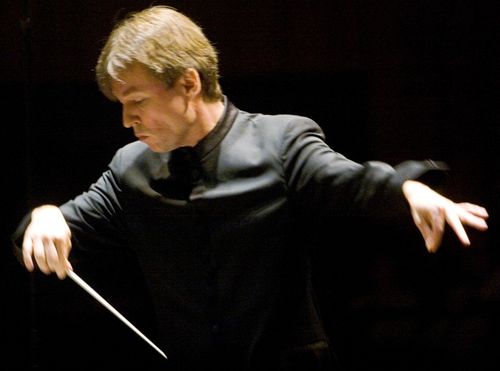
Conductor and composer Esa-Pekka Salonen in flight.
In a music industry where pianists and violinists find themselves leading symphony orchestras, the Finnish composer-conductor Esa-Pekka Salonen is an anomaly. A successful composer, he picked up the baton and started leading concerts in order to get his own music performed.

Mr. Salonen led the Philadelphia Orchestra at the Kimmel Center this weekend, in a program that featured the first Philadelphia performances of his own Violin Concerto with soloist Leila Josefowicz. This work was flanked by familiar works by Bartók and Debussy. The entire program had a spare, European elegance that matched its leader perfectly.

The concert opened with Bartók's Music for Strings, Percussion and Celesta. Conducting the twin string sections, playing them off against each other antiphonally, Mr. Salonen relied on minute gestures of the stick and encouragement from his left hand. The first movement was grim and weighted, developing from a slow fugue that recalls the late writing of Beethoven.

The Philadelphians played this complex opening with a deep, serious tone, before the percussion and piano joined the ensemble in the energetic dances of the second movement. A lengthy xylophone solo, carefully cued by Mr. Salonen, led off the dusky third. That instrument discoursed throughout this slow movement. The fourth moved lightly through Bartók's folk-song inspired dances, lifting to a bold, stirring climax.

Mr. Salonen's own violin concerto was written for Ms. Josefowicz in 2008. This is a narrative work, with the violinist as an athletic, constantly moving protagonist against a pulsing orchestra that alternates between singing and swinging. The opening bars pit the solo instrument against a texture of ancient Chinese gongs, ghostly and hollow. Mr. Salonen's expanded orchestra provided a silky texture in the second movement. 

The third stands in contrast, a vision of hot jazz and urban nightlife with heavy lifting for the soloist. At one point, Ms. Josefowicz duelled with a full drum set, scragging multiple horse-hairs from her bow as she played the fast string figurations. The finale is slow and reflective, rising to deep, emotive perorations before resolving the work in an unusual final chord.

Mr. Salonen took an unusually fast tempo for the opening movement of La Mer, the set of three "symphonic sketches" that stands as one of Claude Debussy's most impressive orchestral achievements. This was a sea rough and ready in its play, with the big climax seeming to float out of the horns, supported by the lapping strings and darting oboe and clarinet. 

The quicksilver tempos continued in the next two movements. Mr. Salonen and the experienced orchestra were perfectly matched, delivering a playful, but not bombastic performance of a work which is in this ensemble's musical DNA. The second movement flowed with dappled light and the spray of salt, conducted with brisk, efficient precision.

The conductor brought the the final dialogue of wind and waves to its final climactic surge, drawing a thunderous sound out of the rich brass and strings. As the house applauded and he walked offstage, Mr. Salonen's hands were still moving, riding the waves of sound that he helped create.  

Friday, July 15, 2011

Concert Review: The Total Perspective Vortex

Night Two of Bruckner (r)Evolution with the Cleveland Orchestra.
Bruckner's music puts everything in perspective for the listener.
With thanks to Douglas Adams for the idea.
The second concert in the Cleveland Orchestra's four-evening survey pairing the late Bruckner symphonies with minimalist composer John Adams outstripped the first. Franz Welser-Möst conducted the second in this concert series, pairing the two composers in an effort to show Bruckner's influence on contemporary minimalists.

The main reason for this was the presence of violinist Leila Josefowicz. The Canadian soloist stunned the audience with her fearless, fleet interpretation of Mr. Adams' three-movement violin concerto, a treacherous composition from the pen of the composer of Nixon in China. Placed next to the Bruckner, the influence of one composer on the other was clear, creating the fresh perspective that is Mr. Welser-Möst's intent.

This concerto is written on a large scale, with a long difficult solo part that never seems to yield the stage to the orchestra. Ms. Josefowicz tore eagerly into the opening movement, and produced sweet lyric tone in the long, slow chaconne. Mr. Welser-Möst accompanied the soloist with a sensitivity, keeping the pace of the chaconne smooth and flowing, with a slow circular groove that was almost percussive in its steadiness.

Ms. Josefowicz displayed astounding technique in the final movement, racing over the chugging ostinato rhythms with such force that she shredded the horse-hair on her bow. Without missing a beat, she conducted a swift bow repair and raced to the finish line of the piece. It was a bravura monologue for this talented soloist, the kind of reading that makes a good case for further exploration of Mr. Adams' music by the most conservative music lover.

Bruckner's Seventh Symphony is the composer's most popular work, the piece which "broke" him with the Viennese public and finally earned the grudging respect of critic Eduard Hanslick. The Seventh is written on the same large scale as the other late Bruckner works, with the addition of four Wagner tubas to the brass choir. This is a hybrid of horn and tuba, invented by Wagner for the first performances of his own Der Ring des Nibelungen.

The Seventh builds to a series of slow, relentless climaxes before pausing and building again, rising to a mighty height at the end of its first movement. The coda of the opening Sonata Allegro pays homage to Wagner himself, with the entire 13-strong brass section playing a chorale that sounds like the opening of Das Rheingold played backward. It is an astonishing effect.

Anton Bruckner.
Bruckner dedicated this symphony to Wagner, and quoted from the composer several times in the score. But these quotes (which range from "Lohengrin" to the Ring do not undercut the power of the second movement, a long, worked-out funerary ode to Wagner, who had died in 1883. This slow movement, which gradually rises to its flowering climax is among this composer's greatest achievements. On the podium, Mr. Welser-Möst respected the composer's intentions and maintined the slow surge of power.

The third movement, a bucolic series of Austrian peasant dances, allowed the conductor and orchestra to show their playful sides. Woodwinds and strings whirled and stomped through the trio section, in the form of a Ländler, a kind of Austrian Alpine hoedown. Mr. Welser-Möst displayed mastery of the tricky triple-double "Bruckner rhythm" that dominates this movement.

The finale elevated the listener back to the heights of Bruckner's sonic mountain, with a return of the opening brass chorale and a new theme developed within the woodwinds. At the work's climax, the backward Wagnerian chorale returned, leaving the listener on the windy heights, under the starry vault, marvelling at the scope of Bruckner's creation. It was a stirring end to the second New York concert by this fine orchestra, who were in excellent playing form and inspired by the exceptional material in front of them.

Bruckner (r)Evolution concludes this weekend with the Eighth and Ninth Symphonies. Tickets are available through Lincoln Center Festival.

Sunday, March 6, 2011

Concert Review: When Orchestras Attack!

The St. Louis Symphony Orchestra at Carnegie Hall
David Robertson, music director of the St. Louis Symphony Orchestra
Saturday night at Carnegie Hall featured the annual visit of the St. Louis Symphony Orchestra. Founded in 1880, the St. Louis forces are America's second-oldest orchestra, and as conductor David Robertson demonstrated, they are one of the most underrated.

The evening opened with an effervescent performance of Ralph Vaughan Williams' Fantasia on a Theme by Thomas Tallis. One of the most enduring examples of 20th century British music, the Tallis Fantasia features three ensembles: a full string orchestra, a smaller ensemble playing in antiphon, and a string quartet--in this case drawn from the SLSO's principal players.

David Robertson led the piece with just the right amount of attaca, producing clean, well-cut phrases from the billowing fabric of the score. He did not allow the meaning of Vaughan Williams' cathedral-like sonic structure to diminish in a wash of pretty sound. The and violin solos were phrased eloquently, and the antiphonal balance was maintained despite having all the musicians packed together on the Carnegie stage.

Thomas Ades' violin concerto Concentric Paths is a muscular, three-movement work. Soloist Leila Josefowicz opened up a dialogue with the full orchestra, playing her instrument with an angry, razor-sharp tone. The first movement featured Bach-like arpeggios led by Ms. Josefowicz.

In the slow second movement, the solo part bobbed and weaved, ducking block-like explosions of percussion and tuba that went off like sonic bombs. The finale featured a dance rhythm not unlike contemporary club or "house" music, but played by the orchestra as contrast to the soaring violin part. This was a tight, well-played, exciting concerto and a good argument for Mr. Ades, an exciting cutting-edge British composer.


Mr. Robertson brought the full force of his orchestra to bear on Tchaikovsky's final symphony, the Pathetique. To that end, he even changed out the principal horns, ensuring that the players would have the necessary resources to make the third-movement march come off without a hitch. The opening movement, with its memorable, descending theme was played with lyricism and longing. The courtly slow movement evoked the glitter of Tchaikovsky's social circle and the composer's own inner doubts.

The famous march featured the best playing of the evening, as the St. Louis brass and horns made the case for the manic side of Tchaikovsky's personality. After allowing the audience to applaud (a tradition at performances of this symphony), Mr. Robertson launched into a passionate, angst-ridden performance of the final slow movement.

This is the the famous cry of despair that seemed to predict both the composer's death and the middle symphonies of Gustav Mahler. It was a compelling finish, and made a case that the St. Louis band deserves a place alongside the "Big Five" American orchestras. "Big Six," perhaps?

Trending on Superconductor

Translate

Share My Blog!

Share |

Critical Thinking in the Cheap Seats