Support independent arts journalism by joining our Patreon! Currently $5/month.

About Superconductor

Our motto: "Critical thinking in the cheap seats." Unbiased, honest classical music and opera opinions, occasional obituaries and classical news reporting, since 2007. All written content © 2019 by Paul J. Pelkonen. For more about Superconductor, visit this link. For advertising rates, click this link. Follow us on Facebook.
Showing posts with label pagliacci. Show all posts

Tuesday, January 9, 2018

Opera Review: The Mystery of the Deadly Double

Roberto Alagna doubles up in Cav-Pag at the Met.
by Paul J. Pelkonen
Ekaterina Semenchuk canoodles with Roberto Alagna in Cavelleria Rusticana, before the
star tenor goes on to sing Pagliacci (right.) Photos by Ken Howard © 2018 The Metropolitan Opera.
On Monday night, the Metropolitan Opera opened the first revival of 2018: a reprise of Sir David McVicar's 2015 production of that durable verismo twin bill: Cavalleria Rusticana and Pagliacci. This run featured the return of Roberto Alagna to the principal tenor roles of each opera (a feat he also managed last season) against the actor who played the two antagonists in the production's premiere: baritone George Gagnidze.

Tuesday, January 2, 2018

Metropolitan Opera Preview: Cavalleria Rusticana and Pagliacci

The verismo twin bill returns in darkness and light.
by Paul J. Pelkonen
Roberto Alagna puts the greasepaint on as the killer clown in Leoncavallo's Pagliacci.
Photo by Marty Sohl © 2016 The Metropolitan Opera.
The Metropolitan Opera revives  its 2015 staging of "Cav/Pag", the most famous double bill in opera. Pietro Mascagni's Cavalleria Rusticana is a story of adultery, revenge and murder (in that order) in a rural Sicilian village. Pagliacci, also  a story of adultery, revenge and murder is centered around a company of traveling players. Both operas end in bloodshed and both star tenor Roberto Alagna in the leading roles.

Wednesday, September 13, 2017

A Clown Shows in Brooklyn

Pagliacci postponed: gang of plucky kids may be responsible.
by Paul J. Pelkonen
Pennywise the Dancing Clown (Actor Bill Skaarsgaard) visits LoftOpera.
Pennywise image © 2017 Lions Gate Studios. LoftOpera image © LoftOpera.
Photoshop by the clown that writes this blog.
Opera lovers may notice a gaping hole in the schedule this week. LoftOpera, that plucky and innovative company that mounts wonderful operas on the cheap has been forced to postpone   its planned production of Pagliacci, the bloody Leoncavallo verismo drama about a clown who goes berserk and murders his wife.

Monday, January 18, 2016

Metropolitan Opera Preview: Cavalleria Rusticana / Pagliacci

The Met revives the bloody verismo double bill.
by Paul J. Pelkonen
Trucking hostile: Marcélo Álvarez in last year's Pagiiacci.
Photo by Cory Weaver © 2014 The Metropolitan Opera.
Although they were written by two different composers, the one-act operas Cavalleria Rusticana (by Pietro Mascagni) and Pagliacci (by Ruggerio Leoncavallo) go together like bacon and eggs. This year, Known in the trade as "Cav/Pag", these two operas are each bloody tragedies of jealousy and murder in small-town rural Sicily.

Wednesday, April 15, 2015

Opera Review: Villains and Vaudevillians

A new Cavalleria Rusticana and Pagliacci bows at the Met.
by Paul J. Pelkonen
Álvarez y Álvarez: tenor Marcelo Álvarez is Turiddu in Cavalleria Rusticana (left, background)
and Canio in Pagliacci (right, insert) in the Met's new David McVicar production.
Photos by Cory Weaver © 2015 The Metropolitan Opera. Photo insertion and alteration by the author. 

At the start of David McVicar's new twin-bill production of Cavalleria Rusticana and Pagliacci, (which premiered last night at the Metropolitan Opera) the curtain rises well before the opera starts, to reveal an enormous circular acting surface, surrounded by chairs. A dim, religious atmosphere pervades the stage, aided by the dark lighting design and the minimal set: huge, vaulted brick walls looming in the darkness. Until the orchestra starts, it's not clear if the first half of this famous pairing (the operas were first staged together at the Met in 1893) is being played, or if it's another new Met production of Parsifal.

Sunday, February 12, 2012

Plácido Clowns Around

"...great tragic clown, come on, check it out, he laughs, he cries, he sings, Pagliacci."--Cosmo Kramer Two reviews are coming. In the meantime, here's some nice Leoncavallo, with Plácido Domingo as Canio in Pagliacci. 

Friday, January 21, 2011

Opera Telecast Review: Pag Before Cav, from La Scala

"I'm gonna go build my own theme park! With blackjack! And hookers! In fact, forget the park!"
--Bender Bending Rodriguez

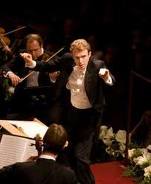
Daniel Harding on the podium
La Scala returned to Symphony Space on Thursday afternoon with a live broadcast of director Mario Martone's new double-bill production of Leoncavallo's Pagliacci and Mascagni's Cavelleria Rusticana. In an unusual decision, the live broadcast switched the verismo twin bill, leading off with Pagliacci.

Martone has set Pagliacci's troupe of players as modern urban gypsies, putting on their show out of the back of a broken down camper, parked under in a highway overpass patrolled by hookers. (What is it with directors who equate verismo with the oldest profession?) Picked out in ugly neon pink and green light this was a sleazy, sordid setting for the commedia dell'arte. And when Silvio (Mario Cassi) picked up a streetwalker while rollin' in his BMW, the director's unsubtle point was made.


The cast anchored by the superior Tonio of bass Ambrogio Maestri. He dominates from his opening "Si puo?" with a dark, rounded tone and a sarcastic leer. Unfortunately tenor José Cura'turns strident when he approaches forte, the voice spreading unattractively in the climactic phrases of "Vestia la giubba." He is not helped by the blunt soprano of Oksana Dyka as Nedda. She was unimpressive in her La Scala debut.

Leoncavallo's most famous opera blurs the line between actors, audience, and onstage spectators, creating a theatrical ambiguity at its climax that is this work's particular genius. Silvio is sitting in the front row of the orchestra when he gets knifed. But having a blood-drenched Canio say "La comeddia e finita" and exit up the main aisle of the La Scala house shattered that barrier completely.

Cavalleria had the opposite problem: an exceptional cast stuck in an unimaginative staging. Lucina D'Into was the chief attraction. Her large, powerful soprano voice copes well with Santuzza's histrionics and heroics, rising effortlessly over the lush orchestra and cutting through the big choral ensembles without sounding shrill or forced. She was ably matched by Salvatore Licitra's exceptional, amoral Turiddu who still somehow elicited sympathy before his death. Bass Claudio Sgura was a fine, dark Alfio--an easy winner in any knife fight.

What didn't work in this Cav was the director's idea of adding a brothel to the village (Alfio was a customer) during the opening scena. (The hookers strike again!) This took away from the lush, succulent phrasing under the baton of Daniel Harding, who led both operas with theatrical flair. Following the church processional, most of the action took place in front of the villagers, gathered in prayer under a giant crucifix. This dark, dull production ended on an empty stage, as if the director had finally run out of ideas.

Trending on Superconductor

Translate

Share My Blog!

Share |

Critical Thinking in the Cheap Seats