Support independent arts journalism by joining our Patreon! Currently $5/month.

About Superconductor

Our motto: "Critical thinking in the cheap seats." Unbiased, honest classical music and opera opinions, occasional obituaries and classical news reporting, since 2007. All written content © 2019 by Paul J. Pelkonen. For more about Superconductor, visit this link. For advertising rates, click this link. Follow us on Facebook.
Showing posts with label iPhone. Show all posts

Tuesday, June 11, 2013

Ring! Ring! It's Rossini Calling!

Cell phone follies at La Scala recital.
by Paul J. Pelkonen
Gioachino Rossini and his little digital friend.
Anybody who goes to classial music concerts or opera performances knows that the modern, digital age has introduced the annoyance of cellular ring tones as unwanted accompaniment to the music of Mozart, Beethoven and Rossini. But on Sunday night, opera star Joyce DiDonato found a new way of coping with the digital menace.

Friday, January 13, 2012

The Return of 'Patron X'

A letter to the readers, and some thanks.
Mysterious blogger Mr. X, now visiting the enchanted Island.
Image of Homer Simpson, © 2000 20th Century Fox/Gracie Films.

It has been 48 hours since I decided to write a story about New York Philharmonic music director Alan Gilbert's decision to stop the fourth movement of Mahler's Ninth Symphony at Tuesday night's concert.

The concert was stopped because of a persistent, ringing iPhone only a few rows away from Mr. Gilbert. (The owner of the phone is a 20-year Philharmonic subscriber, identified only as "Patron X." The phone buzzed its merry "marimba" tune against the swelling textures of Mahler's Ninth, the last work that the composer would live to complete. The conductor stopped the concert until the patron turned his offending instrument off.

Our coverage of the story appears here.

Also recommended: a New York Times interview with Patron X, written by Daniel J. Wakin.

It's been 48 hours since I saw the Facebook post of my friend Kyra Sims, Manhattan School of Music student and horn player. I asked her for an interview very late at night on Facebook chat, and she was willing to give me some excellent details on the events of the concert, including knowledge of the ring-tone. So thanks, Kyra.

Since then, Ms. Sims has been interviewed by Fox News as well. (Other particulars on the story came from Michael Jo's excellent account, available on his site: Thousandfold Echo.)

Since then, (according to the Times report), Patron X "has not slept in two days."

In those two days, the traffic on this blog went absolutely ballistic. Readers have been coming to Superconductor from the New York Times, the Baltimore Sun and network news sites owned by NBC and CBS. Yahoo, Boing Boing, The Awl and Gothamist have all covered the story, alongside my colleagues at the Times, WQXR and National Public Radio. Accounts of the story have spread to Italy and Australia.

If you are one of these new readers who has come to this site following this story, I would like to take a moment to thank you for visiting this site, and to hope that you'll stay for a daily mix of concert reviews, opera coverage, and occasional works of fiction involving the music industry. This blog is about to celebrate its fifth year (next month) and I hope you stay on to read all about it. 


All best, and welcome to Superconductor.

Paul J. Pelkonen, Editor.

Wednesday, January 11, 2012

Mahler, Interrupted

Ringing iPhone stops New York Philharmonic.
by Paul Pelkonen.
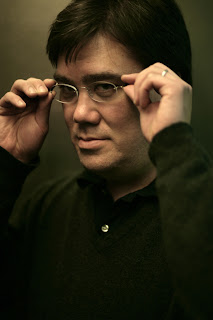
He can kill your cell phone with his brain.
New York Philharmonic Music Director Alan Gilbert.
Photo by Pascal Perich © New York Philharmonic.
Tuesday night's New York Philharmonic performance of the Mahler Ninth was stopped dead by an unusual instrument--the iPhone.

An iPhone (using the marimba ring-tone) went off repeatedly in the fourth movement of Mahler's final completed symphony.

According to an eyewitness, the offending phone owner was in the front rows of Avery Fisher Hall when his phone went off. (A post by Michael Jo on the classical music blog thousandfoldecho.com specifies that the interruption happened just 13 bars before the last page of the score.) In other words, in the final moments of a 25-minute movement, that ends a 90-minute symphony.

"Mr. Gilbert was visibly annoyed by the persistent ring-tone, so much that he quietly cut the orchestra," the concert-goer, music student Kyra Sims, reports. She related how the orchestra's music director turned on the podium towards the offender. The pause lasted a good "three or four minutes. It might have been two. It seemed long."

Mr. Gilbert asked the man, sitting in front of the concert-master: "Are you finished?" The man didn't respond.

"Fine, we'll wait," Mr. Gilbert said.

The Avery Fisher Hall audience, ripped in an untimely fashion from Mahler's complicated sound-world, reacted with "seething rage," Ms. Sims said. Someone shouted "Thousand dollar fine."

This was followed by cries of 'Get out!' and 'Kick him out!.' Some people started clapping rhythmically but the hall was quieted down. House security did not intervene or remove the offender.

The ringing stopped. "Did you turn it off?" Mr. Gilbert asked.

The man nodded.

"It won't go off again?" 

The man shook his head.

Before resuming, Mr. Gilbert addressed the audience. He said: "I apologize. Usually, when there's a disturbance like this, it is best to ignore it, because addressing it is sometimes worse than the disturbance itself. But this was so egregious that I could not allow it."

"We'll start again." The audience cheered.

The final movement of this symphony (marked Adagio: Very Slowly and Restrained) is a long slow meditation on death that eventually fades to silence. The work has special significance at the New York Philharmonic, an orchestra that Mahler conducted in the last years of his life. 

Mr. Gilbert turned to the orchestra and said "Number 118." (Again, thanks to thousandfoldecho.com for this detail.) The band picked up the movement from the final fortissimo ending in the brass, and played the work through to its last, quiet pages.

No other phones went off.


Contact the author: E-mail Superconductor editor Paul Pelkonen.

Trending on Superconductor

Translate

Share My Blog!

Share |

Critical Thinking in the Cheap Seats