Support independent arts journalism by joining our Patreon! Currently $5/month.

About Superconductor

Our motto: "Critical thinking in the cheap seats." Unbiased, honest classical music and opera opinions, occasional obituaries and classical news reporting, since 2007. All written content © 2019 by Paul J. Pelkonen. For more about Superconductor, visit this link. For advertising rates, click this link. Follow us on Facebook.
Showing posts with label dicapo opera. Show all posts

Friday, September 9, 2016

Opera Review: A Tale of Two Opera Companies

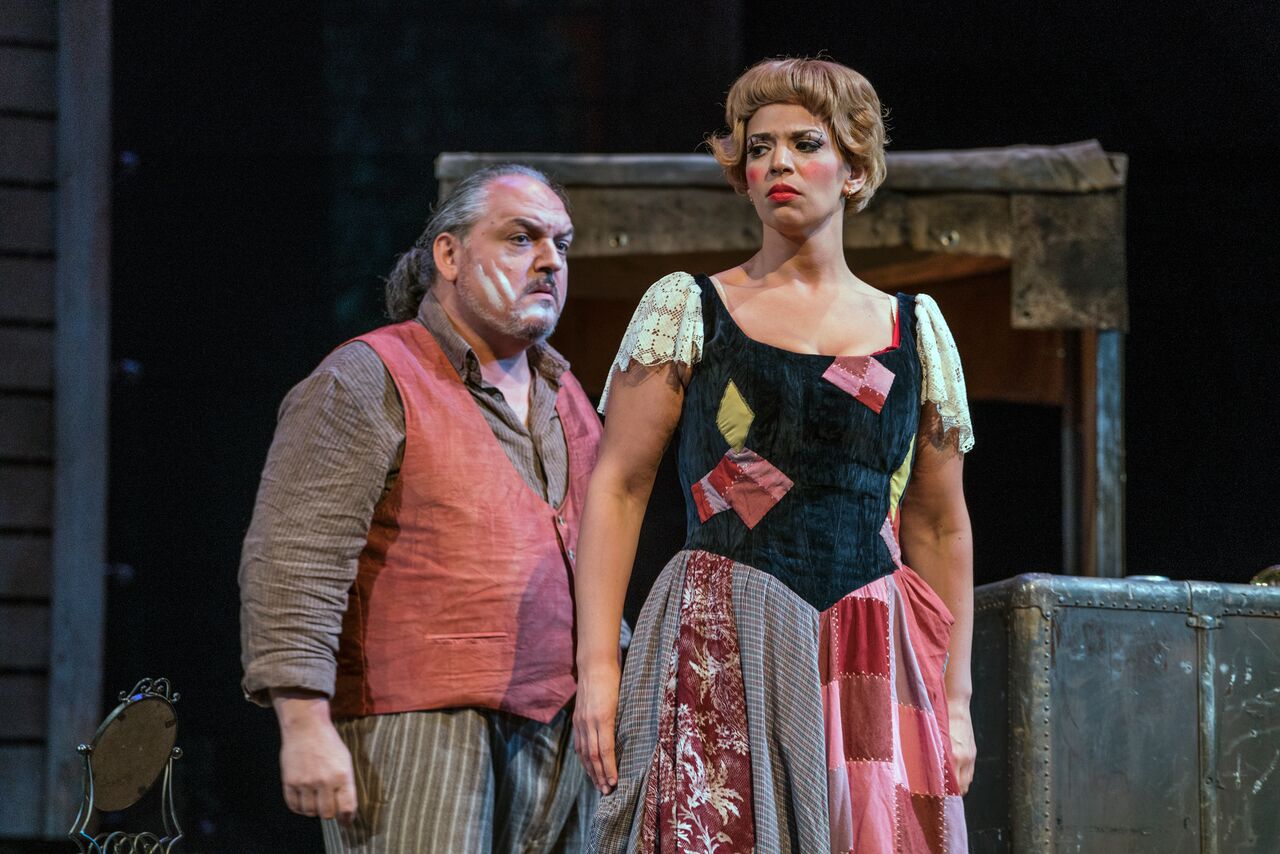
The resuscitated City Opera offers a verismo double bill.
by Paul J. Pelkonen
That's show biz: Canio (Francesco Anile) menaces his unfaithful Nedda (Jessica Rose Cambio)
in Leoncavallo's Pagliacci. Photo by Sarah Shatz © 2016 New York City Opera
Those who have followed the New York City Opera through its recent cycle of death, rebirth and reincarnation know that the man at the helm of this new version of New York's "other" opera company is Michael Capasso. For many years, Mr. Capasso helmed Dicapo Opera, a boutique company on the Upper East Side that provided a welcome alternative to New Yorkers not wanting to make the pilgrimage to Lincoln Center. His company folded in 2013, around the same time that City Opera did, and it makes a kind of sense that he is the head of that larger company's revival effort.

Thursday, December 3, 2015

They're Back From the Dead

And they're ready for Tosca: The New York City Opera Renaissance.
by Paul J. Pelkonen
Original art from Iron Maiden's No Prayer for the Dying.
Painting by Derek Riggs © 1990 Iron Maiden/CBS Records.
The above headline suits the giddy anticipation that some opera lovers in New York have regarding the resurrection of the New York City Opera, the long-running company that bit the dust in 2013. In stories reported yesterday in The New York Times and the Wall Street Journal, it was announced this week that the New York City Opera Renaissance will move forward with its plans to bring the historic company out of bankruptcy and get back to the business of putting operas on the stage.

Thursday, January 30, 2014

The Business of Revivals

Impresario Michael Capasso may save two failed opera companies.
by Paul J. Pelkonen
In his proposal for a New York City Opera Renaissance, impresario Michael Capasso
suggests mounting Franco Zeffirelli's production of Tosca (above)
in Lincoln Center's intimate Rose Theater.
Act I of Tosca. Photo © Teatro Opera di Roma.
In a dramatic turn of events worthy of the operatic stage, two recently darkened New York opera companies have unveiled a plan to join forces and come back to life. The proposal, linked to yesterday on parterre.com (and readable here) comes from Michael Capasso, the general director of the recently dimmed Dicapo Opera. The new hybrid opera company would be called (wait for it)

NEW YORK CITY OPERA RENAISSANCE.

Saturday, October 15, 2011

Opera Review: Giving Mary Magdalene a Black Eye

Dicapo Opera celebrates 30 years with Tosca.
Kristin Sampson stars in Tosca.
Photo by Sarah Shatz. courtesy Dicapo Opera.

There is a moment in Act I of Tosca that I've never seen, until last night. It came when the title character (played by Kristin Sampson) nagged her lover Mario Cavaradossi to paint the eyes of Mary Magdelene black, (like hers) instead of blue. 

In this new production by Dicapo general director Michael Capasso, (staged in celebration of the Upper East Side company's 30th year) Cavaradossi  (played by tenor Peter Gage Furlong) actually mixed paint and blackened Mary's eyes, succumbing to Tosca's demands. It was just one of many small details that made this modest version of Puccini's opera a success. 

If you're not familiar with Dicapo, this company puts on operas in a small "jewel box" theater on W. 76th St. in the basement of St. Jean Baptiste Church. Founded in 1981, it has proved a valuable resource for lovers of chamber operas, modern works of modest size, and repertory favorites staged with an intimacy unavailable at the 4,000-seat Met. 

Kristin Sampson is an experienced singer in this house. She struck the right balance between fiery passion and loopy rage as Floria Tosca. She was tender in the first act, growling and determined in the second (with a pause for a lyric "Vissi d'arte") and positively loopy in the third. In her scene with Cavaradossi on the battlements, she seemed unusually collected as she explained the "staged" execution that was to come. But you could see the doubt in Mr. Furlong's eyes.

Mr. Furlong started with a lovely "Recondita armonia," keeping his lyric tenor voice right in the passagio. He had one shrill moment in the Act I duet with Tosca, when he lifted his voice up to its full height and found that its top was lacking in bloom. Like may tenors before him, he was defeated by "Vittoria!" the stentorian mini-aria that Puccini, (Scarpia-like) may have added just to torment his singers. But "E lucevan le stelle" shone forth in all its glory, with real emotion in the cavalier's farewell to life.

Guido LeBrón's Scarpia was not particularly suave, or seductive. He might have been more at home in Roberti's torture chamber, tightening the spikes himself during the interrogation scene. But he struck an imposing figure in his Act I entrance, thundering out his lust for Tosca in the middle of the Te deum. The second act revealed the police chief as a drooling psychopath, nearly raping Tosca as the room (a turntable set) literally spun around them. His death was staged in the same whirling, distracting manner.

Although the sound of Puccini-sized voices in a small theater can result in balance problems, this Tosca was blessed with a good supporting cast This extended to the smallest roles, with a good performance  from character tenor George Kaserjian (a Mime-like Spoleta) and up-and-coming bass Brandon Coleman in the brief, ill-fated role of Angelotti. The choral work was solid.

It worked well for the Te deum, but the noisy turntable set proved distracting in the later acts, offering different views of the action but putting obstructing scenery in the way of the audience's line of site. In the second and third acts, Puccini's complex orchestrations were forced to battle with mechanical noise. In a small opera house like this one, less is sometimes more.

Thursday, August 25, 2011

The Super-Conductor Opera Preview Part II: The Pooh-Bah Edition

Brought to you by the Lord High Everything Else.
The Lord High Everything Else

Yes, we already published the annual Metropolitan Opera Preview.

It's in that box over there to the right, where we break down the coming season of high drama and music drama at the big limestone skyscraper-on-its-side on what used to be W. 64th St and Amsterdam Ave.

Here, we break down the rest of the coming opera season, from the New York City Opera on down to smaller (but beloved) regional companies in the outer boroughs. This schedule is not complete, and links go to the websites of the respective opera companies and venues.

Anyway, there's some really good stuff coming. Here we go!

September 2011:
  • The opera season gets off to an early start with a run of Francesco Cavalli's Giasone at Le Poisson Rouge in the first week of September. 
  • Les Arts Florissants revives their staging of Atys by Jean-Baptiste Lully, at the Brooklyn Academy of Music, starting Sept. 18. William Christie conducts.

October:
  • BAM starts the month off with a run of Kurt Weill's The Threepenny Opera. Also, Tosca opens the 30th anniversary season of the Dicapo Opera, a charming "jewel box" house on the Upper East Side.
  • The Amore Opera continues the tradition of chamber opera in the East Village with a "Fall Figaro Fest": Mozart's Le Nozze di Figaro, Rossini's Il Barbiere di Siviglia and the U.S. premiere of Mercadente's Il due Figaro, an unauthorized continuation of the adventures of the Almaviva clan, written in 1826.

Peter Maxwell-Davies.
November:
  • Two exciting premieres this month: Juilliard launches their 2011 opera season with the U.S. premiere of Kommiltonen! by composer Peter Maxwell-Davies. 
  • This month also features world premiere of Nico Muhly's opera Dark Sisters by the Gotham Chamber Opera. The new work will run for 10 performances at the Gerald W. Lynch Theater at John Jay College for Criminal Justice. 
  • Angela Gheorghiu makes her one New York appearance of the season, as the Opera Orchestra of New York presents Adriana Lecouvrer at Carnegie Hall.
  • Chelsea Opera offers Menotti's The Medium, and Brooklyn's Regina Opera presents Madama Butterfly.

December:

  • Yale in New York mounts an annual concert series at Carnegie Hall. In the downstairs Zankel Hall, the company will perform William Walton's rarely played one-act opera The Bear. 
  • The Dicapo Opera mounts Tchaikovsky's Iolanta. 

January 2012
  • Wagnerians are already excited at the OONY's plans to mount a concert version of Rienzi at Avery Fisher Hall. Eve Queler conducts. Nice to have Wagner without spinning planks.
  • Opera Lafayette, a period ensemble from Washington D.C. makes its annual visit with Le Roi et le Fermier by Pierre-Alexandre Monsigny. 
  • Another Menotti opera. This time, it's The Consul, presented by the Dicapo Opera.
  • The Bronx Opera presents a rare work by Ralph Vaughan Williams, The Poisoned Kiss. All performances are at Lehman College.
The death of vinyl: Janis Kelly in the Manchester premiere of Prima Donna.
Photo by Tristram Kenton.
February
  • Claiming "all of New York" as its stage, the revamped New York City Opera opens at...BAM. The company will offer a Jonathan Miller staging of La Traviata (from their old partners at Glimmerglass Opera.) Also, the eagerly anticipated U.S. premiere of singer/songwriter Rufus Wainwright's anticipated opera Prima Donna.
  • The Met and Juilliard present a co-production of Armide featuring promising young Juilliard artists. This is a follow-up to last year's The Bartered Bride. Gluck's opera will be conducted by Jane Glover. This may be a tough ticket, as it is (probably) a sneak preview for an upcoming Met production.
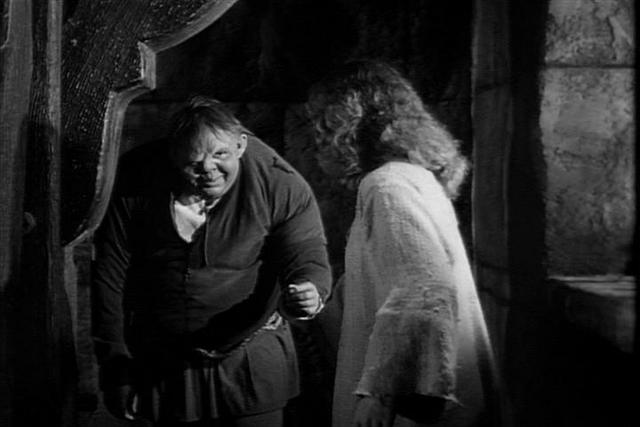
Not Rigoletto: Charles Laughton (left) as Quasimodo
with Maureen O'Hara in The Hunchback of Notre-Dame.
© 1939 RKO Radio Pictures.
March
  • City Opera moves again, to the Lynch Theater for a new production of Mozart's Così fan tutte. On a happier note, Dicapo Opera presents The Most Happy Fella, and the Regina Opera offers Cavalleria Rusticana, paired with a short concert. 
  • Leon Botstein and the American Symphony Orchestra present a concert performance of Franz Schmidt's Notre-Dame, a rare setting of Victor Hugo's story of a love-struck hunchback. (Not Rigoletto. The other one.)
  • Finally, OONY offers a TBA opera with Placído Domingo. Betting books will open before the announcement is made. Well, not really.

April
  • As the Met's Ring creaks into high gear, Gotham Chamber Opera will present a rare Mozart work: Il Sogno di Scipione. At the Lynch Theater at John Jay.
  • Dicapo pits their Violetta against the Met's with their own production of La Traviata. (No Ikea furniture is involved.) 
  • Also, the Juilliard School mounts another staging of Don Giovanni. This one is by Stephen Wadsworth.
May
  • In their final migration of the season, New York City Opera presents Telemann's Orpheus at El Museo de Barrio on the Upper East Side.
  • The Bronx Opera winds down their season with Hansel und Gretel at Lehman College.

Trending on Superconductor

Translate

Share My Blog!

Share |

Critical Thinking in the Cheap Seats