Support independent arts journalism by joining our Patreon! Currently $5/month.

About Superconductor

Our motto: "Critical thinking in the cheap seats." Unbiased, honest classical music and opera opinions, occasional obituaries and classical news reporting, since 2007. All written content © 2019 by Paul J. Pelkonen. For more about Superconductor, visit this link. For advertising rates, click this link. Follow us on Facebook.
Showing posts with label boxed sets. Show all posts

Thursday, September 29, 2011

Tchaikovsky Gets Boxed

Composer's Music Opens Carnegie Hall, Focus of New Box Set
Piotr Ilyich Tchaikovsky, who conducted the opening of Carnegie Hall in 1871.
The always interesting budget label Brilliant Classics have unleashed their latest boxed set edition containing all (or most) of the published works of a major composer. Piotr Ilyich Tchaikovsky is the latest to get this treatment, in a 60-disc edition containing all of the orchestral works and most of the operas.

As with past Brilliant Classics editions, this set is a compilation from different labels. Here, the major operas and some of the minor ones are drawn from Russian opera companies, including a Bolshoi recording of Pique Dame and Mazeppa, and a pre-Valery Gergiev Kirov performance of The Maid of Orleans. Rare works include the early opera Oprichnik in an Italian radio recording under Gennady Rozhdestvensky.

The six symphonies are here, recorded by the London Symphony Orchestra under Rozhdestvensky and the Tchaikovsky Symphony Orchestra of Moscow Radio under Vladimir Fedoseyev. The ballet scores are the old (but excellent) recordings made by Ernest Ansermet and the Orchestre de la Suisse Romande. The set is rounded out with songs, piano works, and other rare Tchaikovsky works, many drawn from the old Soviet archives.

On October 5th, Carnegie Hall is celebrating the 150th anniversary of its opening concert, which was conducted by Tchaikovsky in his one visit to New York City in 1871. The season kicks off with Valery Gergiev, leading his Mariinsky Orchestra forces in a gala performance featuring guest soloist Yo-Yo Ma.

The program opens with Shostakovich's Festive Overture, followed by Tchaikovsky's Rococo Variations for 'cello and orchestra. Rimsky-Korsakov's orchestral showpiece Scheherezade ends the program, which will be performed without intermission.

On October 6, the regular Carnegie Hall season opens with a week-long stand featuring Mr. Gergiev and the Mariinsky Orchestra. The first three concerts, on Oct. 6, 9 and 10 will feature all six Tchaikovsky symphonies, with two on each program. The final concert, on Tues. Oct. 11 features Prokofiev's ballet score Romeo and Juliet, the First Tchaikovsky Piano Concerto with soloist Daniel Trifonov, and Shostakovich's First Symphony.

Sunday, September 25, 2011

Re-stocking the Bare Shelves

A look at upcoming classical boxed sets.
"My cans. My precious, antique cans. Look what you've done to 'em."
Every Fall, the classical music industry releases a new flood of boxed sets and reissues into the warehouses of Amazon.com and its competitors. (This line used to read "into the record stores" but since there are very few left age their stock is limited, I decided to update it for this barren decade.)

In times of limited employment and deep economic strife, suggesting which classical/opera boxed sets to collect might be as futile as buying a subscription to the New York City Opera's 2011 fall season. But we're still going to do it anyway, because writing about good music is a light in dark days.

Here's some new and notable box sets. Some are recently released. Others are coming in the next few months:

Rafael Kubelik conducts Great Symphonies
Schumann Symphonies 1-4, Bruckner Symphony No. 3, 4, Mozart Nos. 35, 36, 38-41

Bavarian Radio Symphony Orchestra cond. Rafael Kubelik (RCA, 7 discs)
One of the great underrated conductors gets a reappraisal, thanks to the merger of Sony and RCA and a slew of accompanying reissues. Kubelik always had a unique take on major repertory, and he meshed perfectly with the Munich forces to produce gorgeous results. (Release Date: Sept. 6, 2011)


Schubert: Piano Sonatas and Impromptus, Andras Schiff, Piano (Decca, 9 discs)

This Hungarian pianist made these Schubert recordings in the 1990s. Crisp keyboard diction, beautiful digital sound and a sense of intimacy, especially in the beautifully played Impromptus. (Oct. 18, 2011)

Bruckner: Symphonies 0-9
Chicago Symphony Orchestra cond. Daniel Barenboim. (DG, 10 discs)

This set has been out of print for almost two decades, mostly because Daniel Barenboim decided to record a second Bruckner cycle with the Berlin Philharmonic. That set was released in the '90s on Teldec/Warner Brothers and is also currently available. This older, analog set made in the 1970s offers the conductor's fiery first take on these classic works and allows the listener to hear the early relationship between the young Barenboim and this great American orchestra. (Oct. 18, 2011)


EMI Sergiu Celibidache Edition Boxed Sets
Munich Philharmonic cond. Sergiu Celibidache (EMI Classics, Four boxed sets, 48 discs total.)

Four low-price boxed sets celebrate the "all-bootleg" recorded legacy of this idiosyncratic, but inspired Romanian conductor. Since Celibidache would not make studio recordings and openly disapproved of the process of making live recordings, he had to be recorded quietly, with everything released following his death.

The maverick Celibidache famously eschewed the recording studio, leading mystic, revelatory performances of major symphonic repertory. (Most of these recordings were made between 1982 and 1995, but not intended to be released.) Bruckner is the main attraction here, although this conductor applied his unique touch to Bach choral works, the Verdi Requiem and an astonishing range of repertory from Haydn and Mozart to Debussy, Bartok and Mussorgsky. (Oct. 25, 2011)


The Liszt Legacy: Benno Moisewitch, Alicia De Larrocha, Claudio Arrau, Raymond Lewenthal, Egon Petri, Piano (DG, 11 discs)
This year has seen a slew of Liszt boxed sets, from the scattershot anthologies of EMI and Sony to Hyperion's absolutely complete set of Leslie Howard's recordings, that weighs in at a hefty 99 discs. This ten-disc Liszt-a-thon celebrates the composer's bicentennial with rare and unreleased recordings of the composer's works from five great pianists. Many of these are previously unreleased.

The Chilean Claudio Arrau and the Spanish Alicia de Larrocha are the big names here, but the set is also notable for the inclusion of the underrated Benno Moisewitch as well as the more obscure Dutch-German pianist Egon Petri and the American-born Raymond Lewenthal.  (Nov. 15, 2011)

Sunday, July 10, 2011

CD Review: Zinman's Zurich Zauberkunst

Mahler: Symphonies Nos. 1-10. Tonhalle Orchestra Zurich cond. David Zinman
(15 SACDs + 1 DVD, RCA/Sony Classical, 2007-2010)
The cover of the new Mahler box. Painting by Augustin Giocometti.
This boxed set collects David Zinman's brisk, no-nonsense recordings of Mahler's ten symphonies (including the Clinton A. Carpenter completion of the Tenth, but no Das Lied von der Erde.) The Swiss forces are not as showy a "name" as the Vienna or Berlin Philharmonics or the American "big five." But on these recordings, they play Mahler with freshness, enthusiasm and love for this composer's particular genius. They are led by the American Mr. Zinman, who chooses brisk, but not rushed tempos, with some exceptions.

Throughout these performances, (recorded in the Tonhalle from 2007 to 2010) Mr. Zinman shows great attention to the details and subtleties of these scores, preferring the complex textures of Mahler's wind writing to the big blasts of brass bombast. The opening bloc of Wunderhorn symphonies (Nos. 1-4) are solidly performed, with rich brass playing and energetic strings and winds. Mr. Zinman has a firm grasp of Mahler's treacherous rhythms, making the sudden celebratory dance in the middle of the Symphony No. 1 Marcia funebre lurch to playful life. The "Blumine" movement (excised from Mahler's First symphony right before the work's premiere) is included as an appendix.
David Zinman. Photo by Priska Ketterer.
Mr. Zinman tackles the largest movements of the Second (the final "Resurrection") and the Third ("Pan Awakes") with fearless command, unveiling great structures from Mahler's complex musical architecture. "Pan Awakes" is especially compelling. The famous (and under some conductors, interminable) extended repeat in the latter movement is played with gusto, as if the Swiss brass can't resist a second chance to blast through Mahler's summery march. But after all this bombast, the Fourth is a bit of a let-down. The performance has the right funereal atmosphere, but lacks Mahler's grim humor.

The three "middle" symphonies (Nos. 5, 6, and 7) benefit from the wide, detailed dynamic range. Mr. Zinman chooses interesting, not always predictable spots to slow the pace, producing new effects without distorting the original works. The Fifth journeys from the brassy funeral march to its triumphant close, with a brief, intimate stop at the Adagietto. The Sixth (with its Adagio placed in the second position) simply kicks ass, starting with the heavy metal stomp of the low strings in the opening movement and the contrasting second theme. The whole climaxes in the crushing hammer-blows of the grim 30-minute finale.

Mr. Zinman also solves the mysterious Seventh, bringing out new details in this strange nocturnal journey. The central three movements (two Nachtmusiks bookending the grim Schattenhaft are played in a continuous flow. The whole ends in a brassy blaze of light. For once, this finale does not sound like a cheap knockoff of Meistersinger! That blaze of light continues into the problematic Eighth, with its titanic forces for voice, chorus and orchestra. The textures of "Veni, Creator Spiritus" are stretched to their absolute limit. The "Faust" climax is also slow, with an ardent performance from tenor Anthony Dean Griffey to the fore. The brass give all their worth.

One of the joys of this set is the wrenching Ninth, a symphony that can go disastrously wrong on record. The opening, faltering heartbeat is perfectly played, with muted, jarring brass. The Rondo-Burleske
whirls and capers. The final fade-out leaves the listener shattered. Mr. Zinman also does well by the (completed) Tenth, making the symphony more than just a Mahlerian afterthought. After a tremendous reading of the opening movement, he makes an intelligent argument for Mr. Carpenter's completion of the latter four movements. Those familiar with the "standard" Deryck Cooke completion may find this a more satisfying effort to solve this unfinished work.

Footage of David Zinman rehearsing the Mahler Sixth, from Going Against Fate.

This is a lavish box, spreading the works across 15 Super Audio CDs. They are packaged in individual slip-cases that replicate the CD covers, showcasing art-works that are currently in the collection of the Kunsthaus Zurich. It also includes a fascinating documentary, Going Against Fate, that chronicles the sessions for the Sixth Symphony. The film delves into the complexities of playing in a modern state-sponsored orchestra, from the tuba player's need for brass oil to a bassoonist demonstrating the proper way to wrap and blow a double reed. For this writer, the highlight was hearing Mr. Zinman offer a verse of "Alma", the satiric lied about Mahler's widow, written by Tom Lehrer. It was a wonderfully irreverent moment in the midst of a worthy recording project.

Tuesday, November 30, 2010

The Superconductor Gift Guide III: Some Stocking Stuffers

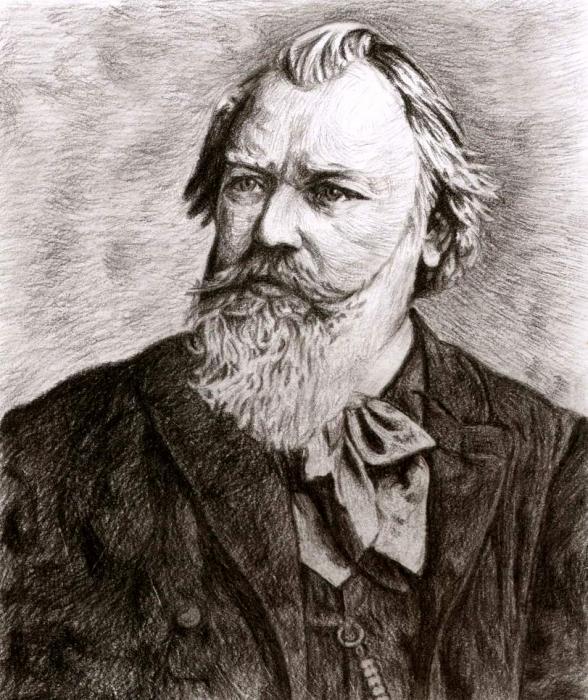
Johannes Brahms, looking less than jolly.
Drawing by Andrey Volkov

OK. Before you all start writing me letters about how all five box sets in this article are Deutsche Grammophon reissues, I want you to know that I'm aware of that. It just happens that these are five of the best CD box sets released in 2010. It's a coincidence that they're all on the same label.

Really. I swear on my little brass bust of Beethoven.

Anyway, here's the list:

Boulez Conducts Stravinsky
This set collects the Stravinsky recordings made by Pierre Boulez at the start of his fertile second summer as a recording conductor. They feature three great orchestras (Chicago, Cleveland and the Berlin Staatskapelle) and clarity of texture These performances were made in the 1990s, with great international orchestras: the Cleveland Orchestra, Chicago Symphony Orchestra and the Berlin Staatskapelle.

These recordings range from the major Stravinsky ballet scores to dramatic poems and the lesser-known works from his neo-classical period. Everything here is played with exceptional clarity of texture, driven, yet not rushed tempos, and a keen understanding of Stravinsky's fearless experimentation from a composer known for his own avant-garde ideas.


Emerson String Quartet: The Complete Beethoven String Quartets.
This set leapt to the very top of the heap of Beethoven string quartet recordings when it was released in the late '90s. Here, it returns to the catalogue as part of DG's 'Collector's Edition' series, which helps music lovers save considerable amounts of shelf space.

The Emersons offer driving, muscular interpretations of the sixteen Beethoven quartets in glittering digital sound. Highlights of the cycle include a lyric trio of 'Razumovsky' Quartets, and a beautiful run-through of the famous 'Harp' Quartet.

The best part of the set is the Emersons' fearless exploration of the difficult final quartets. They offer both the 'Grosse Fugue' (originally written as the finale for Quartet No. 15) and the tamer 'alternate' movement, played with the same sence of precision and skill. By the time the last quartet is reached, the listener may finally understand why Beethoven scrawled "Muss es sein?...Es muss sein!" on the manuscript. If you figure it out, write in and tell us. We love mail.


Martha Argerich: The Collection 3: Chamber Music
This is the third installment in a series of box sets reissuing Martha Argerich's DG recordings. The first two focused on her solo recitals and recordings of the major piano concertos, and are also highly recommended.  The discs are repackagings of the original album releases, with the CDs coming in miniature replica LP jackets.

For those of you not familiar with Ms. Argerich's work, she is a brilliant, refreshing pianist whose fearless technique shot her to the top of the classical music world by the age of 21. In her maturity, she moved away from solo recitals, preferring to perform with other pianists or in small groups.

Here, the label says "chamber music" but a better title might be "Chamber works and music for two pianos." Of the six discs, the highlight is definitely a series of two-piano arrangements of works by Ravel, Prokofiev and Tchaikovsky. Most of these are performed in collaboration with Russian pianist Mikhail Pletnev, and they offer an interesting angle on Ms. Argerich's piano skills. That they're gorgeous performances which kick major ass is also part of their appeal.


Vladimir Horowitz: The Complete Recordings on Deutsche Grammophon
Vladimir Horowitz is one of the most important pianists of the 20th century, a master of the instrument who specialized in Chopin and the knotty, cerebral music of Alexander Scriabin. These recordings were made in a fertile period of two years at the end of the great pianists' life, and preserves his final recital in Hamburg, as well as works by Schubert, Schumann and Mozart.

The major performance here is the Moscow Concert, which is also available separately. Vladimir Horowitz returned to his homeland in 1986 as part of a cultural exchange with the then Soviet Union. He performed a scintillating program ranging from the early keyboard compositions of Domenico Scarlatti to his standard Romantic repertoire of Schumann, Liszt and Rachmaninoff.

This set was originally issued on just four discs, but this new version consists of seven seperate discs, each packaged in a replica of the original LP sleeve. (The content, however, is the same.) On the bright side, the label didn't jack the price of the music, which is priceless no matter how it's packaged.


Vladimir Horowitz playing Mozart in Moscow


Hugo Wolf: Lieder
If you're not conversant with German art-songs, the name Hugo Wolf may be entirely new to you. Wolf's music follows in the expression of Romantic ideals set forth by Wagner and Liszt, but with the musical ideas compressed into tight, powerful songs that say in five minutes what it takes Wagner six hours to express.

This brilliant collection is a welcome reissue from the vault, featuring the consumnate, intelligent interpretations by baritone Dietrich Fischer-Dieskau. The young Daniel Barenboim is an ideal accompanist--and would go on to become a great Wagner conductor in his own right.


Wolf's music isn't exactly Christmas-time listening. His songs are settings of dark, Romantic poetry, and the harmonic brilliance and chromaticism can take getting used to. But this is an essential set, folks, with the finest baritone for this music: a dramatic, intelligent singer who finds the soul in each one of these five-minute gems. 

Saturday, November 27, 2010

The Superconductor Holiday Gift Guide: Mega Box Sets

Johannes Brahms after Black Friday.
Instead of battering down the doors of the local emporium this year, Superconductor presents our guide to great bargains, box sets, and musical experiences to lend the glorious sound of good music to the holiday season.

Gosh, that sounded pompous. Let's try that again. Here's some holiday stocking-stuffers for the music fiend on your Christmas list. And if any of them get returned, let me know.

We start with the box sets.

Verdi: Great Operas From La Scala
This set has been mentioned on my page a few times. It makes a great gift for the lover of Italian opera in your life. You get recordings of most of the major Verdi operas.  The "big three" are here (Rigoletto, Trovatore, Traviata) alongside essential recordings of Macbeth, Don Carlo, Aida, and Un Ballo in Maschera and a good Verdi Requiem. Most of these recordings were made in the heyday of vinyl, and about half of them are conducted by Claudio Abbado, a fine Verdi conductor.

The real picks here are the Boccanegra with Mirella Freni, José Carreras and Piero Cappuccili as the Doge. This is one of the best Verdi recordings ever made. The Trovatore features Carlo Bergonzi singing his lungs out in the title role. 21 discs for about $40.

Bach: Sacred Masterpieces and Cantatas


John Eliot Gardiner is one of the most important conductors working in the field of 'period' instruments: playing classics on the original instruments used in the 17th and 18th centuries or facsimiles thereof. Here is a reissue of all of his Bach choral masterworks: both Passions, the Christmas Oratorio, the Mass in B Minor

There's also twelve discs worth of cantatas. These were recorded as part of a projected plan to record the entire cycle of Bach cantatas. That plan was aborted by the label when the conductor and his orchestra were unceremoniously dumped from DG Archiv as part of the great classical music purge around the turn of the century. However, the English Baroque Soloists, the Monteverdi Choir and their conductor  recorded a complete cycle of the cantatas on the Soli Deo Gloria label.

These are fine recordings with strong casts, wonderful ensemble playing and a sense of overall guidance from the podium. If you want to start listening to Bach's vocal music, this is a good place to start. 22 discs for $55.

The Complete Brahms Edition and Schumann: The Masterworks
Two big white cubes of 19th century romanticism from Deutsche Grammophon. The Brahms box is a reissue of a project that originally came out in the '90s. You get songs, symphonies, piano works and more in a vast sweep of the Universal Classics vault. The Schumann is more interesting, even if the works herein are more obscure. Good symphony recordings (John Eliot Gardiner in Romantic mode) piano music, songs, and best of all, the rare vocal works: Scenes from Goethe's Faust and Die Paradies und die Peri. Great stuff for less than $100 apiece.

Bernstein: The Symphony Edition
A whole load of Bernstein recordings made in conjunction with the New York Philharmonic back in the salad days when "Lehnutt" was music director of the Big Apple's biggest orchestra. The Sony Classical set includes complete cycles of symphonies by Beethoven, Brahms, Haydn's "Paris" and "London" symphonies, Mahler Schumann, Sibelius, Tchaikovsky, and of course, Bernstein. But there's also modern music by Schuman, Shostakovich, and others. 60 discs for about $100 and they've all been remastered.

Karajan 100th: The Complete EMI Recordings:
Vol. 1: Symphony and Orchestral. Vol. 2: Opera and Vocal
This was actually released in 2008 to commemorate the 100th birthday of Herbert von Karajan, the Austrian-born conductor who was instrumental in bringing recorded music into the digital age. The EMI recordings are available in two box sets, of about 80 discs each. The trade-off: all the discs packed tightly into cardboard sleeves.

The sets include many classic HVK recordings: his Der Rosenkavalier with Elisabeth Schwarzkopf, the Pelleas et Melisande with Frederica von Stade, and a vast legacy of symphonic recordings from Mozart to the modern age. Best of all, these recordings date up to 1984, before Karajan's late-career decline and the "Karajan Gold" series. Each set is about $130 apiece, which comes out to $2 a disc. Your ears will thank you.

Trending on Superconductor

Translate

Share My Blog!

Share |

Critical Thinking in the Cheap Seats