Support independent arts journalism by joining our Patreon! Currently $5/month.

About Superconductor

Our motto: "Critical thinking in the cheap seats." Unbiased, honest classical music and opera opinions, occasional obituaries and classical news reporting, since 2007. All written content © 2019 by Paul J. Pelkonen. For more about Superconductor, visit this link. For advertising rates, click this link. Follow us on Facebook.

Monday, June 6, 2011

CD Review: He Knew Where His Towel Was

James Levine's 1970s Mahler Symphonies
by Paul J. Pelkonen
James Levine: the early years. Photo from Metropolitan Opera Archives.
The current epidemic of Mahler mania (2010 and 2011 mark both the composer's 150th birthday and the centennial of his death) has caused the four remaining major record labels to flood the shrinking market with reissues of Mahler symphonies. This "incomplete" set of Mahler symphonies (the Second and Eighth are missing) features a much younger, healthier James Levine, at the peak of his powers and staking his claim as a great conductor of Mahler's music.

Sunday, June 5, 2011

Opera Review: A Modern German Take on Greek Myth

Henze's Phaedra Premieres in Philadelphia.

Cage match: A scene from Act Two of Phaedra. 
Photo by Katherine Elliot, © 2011 Opera Company of Philadelphia
This weekend at the Kimmel Center, the Opera Company of Philadelphia concluded its 35th season with Hans Werner Henze's 2007 opera Phaedra, a knotty work steeped in German serialism and Greek myth. The performances, conducted by Corrado Rivaris, mark the work's United States premiere.

The story is based on Euripides' treatment of the Phaedra myth. Phaedra is the wife of Theseus, the Athenian hero best known for slaying the Minotaur in the Labyrinth of Knossos. The opera opens with the death of the beast. Things take a sharply personal turn as Phaedra falls in love with her step-son Hippolyte, an illicit affair that results in disaster and the latter's death.


Henze originally stopped there, but real life led to the creation of a second act. In 2005, the composer was struck with a mysterious illness and fell into a coma for two months. Upon reviving, he worked with librettist Christian Lehnert to provide a second act and create a scenario in which Hippolyte is resurrected and crowned as king of the forests by the goddess Artemis. The final result was a 75-minute opera in two acts, performed here without an intermission.

The score of Phaedra owes much to Richard Strauss' late style and the 12-tone writing of Alban Berg. Henze makes use of a powerful brass and wind sectin in his score, supporting them with an elaborate percussion section and minimal strings. Tuned keyboard instruments are featured alongside "found" sounds, including the recording of a buzz-saw and what might be the first cellular phone ever used in an opera. Unusual amplification of instruments like the harp provide dense, otherworldly textures, a fitting background to the fantastical plot.

This work proved potent in performance. Mezzo-soprano Tamara Mumford (Flosshilde in the Met's new Das Rheingold) brought physical and vocal athleticism to the title role. Heroic tenor William Burden was compelling as the dead-then-resurrected Hippolyte, the object of his step-mom's obsession. The hunt goddess Artemis was subject to some gender-bending, with countertenor Anthony Roth Costanzo singing the part. Mr. Costanzo's performance combined impressive vocal gyrations with a fierce dramatic heart. Finally, Elizabeth Reiter was impressive in the small role of Aphrodite, singing her duet with Phaedra to Hippolyte as he was trapped in a cage.

If Phaedra sounds like heady, pretentious stuff, it is. But it also the latest in a long operatic tradition of putting fresh spins on familiar mythology, one that stretches from Monteverdi's Orfeo, through the operas of Handel, Haydn and Mozart to the late stage works of Richard Strauss (Daphne and Das Liebe der Danaë.) At this late state in his career, the octegenarian Henze makes his case as an important composer of opera, a visionary whose work can still compel and thrill the adventurous listener.

Saturday, June 4, 2011

If I Ran the Zoo City Opera

"So I’d open each cage. I’d unlock every pen, let the animals go, and start over again."
 from If I Ran the Zoo by Dr. Seuss.
"I have just created something totally illogical."
--Ray Kinsella, from Field of Dreams.
The Nerd, from If I Ran the Zoo by Dr. Seuss.
© 1950 renewed 1978, the Estate of Theodore Geisel/Dr. Seuss. Published by Random House.

A little thought experiment, bloggers. Let's say that I, your humble scribe, suddenly found myself at the head of a certain opera company that used to occupy the New York State Theater. The economy has recovered. The Republicans: curiously silent. A certain industrialist took his name off the building. The opera company moved back in, and could afford to put on a real opera season: ten operas that people would want to see.
And things were just peachy keen.

What kind of a season would I put together?

Allow me to wax poetic....

What kind of an opera season could there be,
if New York's City Opera was managed by me?

It is such a challenge in these trying times,
when arts are defunded by right-wing pond-slimes.

But think on this fancy. And give it some weight,
I'd put on TEN operas: an ambitious slate!

Minor works by Puccini! They're audience-pleasing:
La Rondine paired with Schicchi to kick off the season.

Our schedule would echo with two guys named Strauss,
First Daphne by Richard, then Die Fledermaus.

But waltzes and myths aren't all that draw raves,
It's Eye-talian opera that New Yorkers crave.

Let's not forget Verdi, great man of the theater:
A new-mounted Falstaff: nothing could be sweeter.

The music of Korngold can melt one's cold heart
For spring, Tote Stadt would make a good start.

Boito's clever devil: Mefistofele,
with the right basso lead they'd be whistling with glee.

And of course dear reader it's the story of Faust,
Let's pair it with Gounod's! Then paper the house!

Our Gypsy friend Carmen t'would brings list'ners pleasure,
To cap it all off, here's a sweet baroque treasure:

It's Handel's Semele: she'll rake in a few bucks!
A relic from before the house ran out of luck.

Maybe I'm just dreaming it back from the dead.
But what if City Opera wasn't drowning in red?

Friday, June 3, 2011

Concert Review: Back For the Future

NY Philharmonic Returns, with New Music and rare Bruckner.

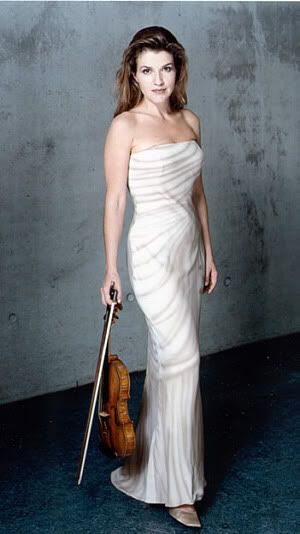
Woman in White: Anne-Sophie Mutter and friend.
The New York Philharmonic has returned from its European tour to kick off four weeks of concerts at its home base of Avery Fisher Hall. On Friday afternoon, the orchestra offered an unusual program featuring Time Machines, a new piece by Sebastian Currier, commissioned by artist-in-residence Anne-Sophie Mutter. The new work was flanked by a rare Beethoven trifle, and a Bruckner symphony that the orchestra hadn't performed live in 40 years.

Written in 2007 but shelved until this week, Time Machines is not a memorable piece. It is another installment of Ms. Mutter's ongoing (and commendable) quest, as she seeks to expand the repertory of her instrument. Over seven movements, Mr. Currier establishes a call-and-response between the soloist and orchestra, exploring different rhythmic approaches and concepts of time. Ms. Mutter opened the first movement with growled, staccato chords, a repeated ostinato which was answered by the orchestra strings.

The major themes of the opening were expanded upon and repeated in the movements that followed, giving listeners a sensation of traveling backwards in time, with room to move for Ms. Mutter's instrument against a shifting curtain of strings, wind, and odd percussion. There were slow, soothing minimalist passages (entropic time) alternating with frantic fast sections (compressed time.) The most impressive section: backwards time, with inversions and retrogrades of the original thematic material, adding to the sensation of time running backward.

The concert opened with Beethoven's first Romance for Violin and Orchestra, featuring the talents of Philharmonic artist-in-residence Anne-Sophie Mutter. Clad in a spectacular scarlet sheath and wielding her bow with authority, Ms. Mutter captured the lovely lyricism that one associated with Beethoven's work, illustrating how this admittedly minor piece points the way to the heights of the composer's lone violin concerto.

The Philharmonic waited four decades to bring back Anton Bruckner's underrated Second Symphony, a taut, powerful work that excels and surprises, precisely because it lacks the sheer orchestral overkill associated with this Austrian composer. On the podium, music director Alan Gilbert made Bruckner's characteristic rhythms (one-two, one-two-THREE) snap, showing the crisp architecture and tight structures present in the music of a composer who remains misunderstood today.

The Second falls into Bruckner's early period, and (through some complicated numbering issues) is actually his fourth, possibly fifth effort in the genre that he made his life's work. It stands as a bridge between the symphonies of Beethoven and Schubert and the giant structures of sound that the composer worked on at the end of his life. Known (for lack of a better nickname) as the "Symphony of Pauses," the work frequently stops for a full rest, and then picks up the theme from its beginning, restating it in what is essentially a hybrid between a theme-and-variations and traditional sonata form.

The performance featured some beautiful playing from four of the Philharmonic horns, led by principal Philip Myers. The English horn made an important contribution in the slow movement. The trio of the rousing Scherzo (based on the Ländler, a curious Austrian peasant dance that was a Bruckner favorite) featured a gorgeous solo from violist Cynthia Phelps. And the mighty final movement was the sum total of Mr. Gilbert's abilities at keeping a large structure of music intact, making the work rise consistently to its thrilling, thundering climax.

Trending on Superconductor

Translate

Share My Blog!

Share |

Critical Thinking in the Cheap Seats