Support independent arts journalism by joining our Patreon! Currently $5/month.

About Superconductor

Our motto: "Critical thinking in the cheap seats." Unbiased, honest classical music and opera opinions, occasional obituaries and classical news reporting, since 2007. All written content © 2019 by Paul J. Pelkonen. For more about Superconductor, visit this link. For advertising rates, click this link. Follow us on Facebook.

Saturday, February 12, 2011

Concert Review: There is Nothing like a Dame

Mitsuko Uchida at Carnegie Hall

Even Knight Commanders have a sense of humor: Dame Mitsuko Uchida.
The acclaimed concert pianist Dame Mitsuko Uchida made a triumphant appearance at Carnegie Hall on Friday night. The program: a celebration of the pianistic innovations of Beethoven, Schumann, and Chopin. Although these are three familiar composers, Ms. Uchida's interpretation made these familiar works sound cutting-edge.

For two hours, Ms. Uchida (currently touring to promote a CD of Schumann recordings) enthralled the capacity audience, which included last-minute audience seating on the famed Carnegie stage. Throughout, she played these Romantic works with a delicate, neo-classical approach, leaning on the pedal and brushing the keys with a gossamer touch.


On her previous visit to Carnegie Hall, Ms. Uchida played the last three Beethoven sonatas. For this concert, she chose No. 27, the two-movement E minor sonata, which stands on the cusp between the composer's 'heroic' middle period and the experimentation of his last years. Hers was a fresh interpretation, playing Beethoven's passages with a gentle, flowing legato Even though she bareley seemed to move her hands, a shower of silver sounds poured forth.

Robert Schumann's Davidsbündlertanze (Dances of the Group of David) chronicle the internal struggle between Schumann's two writing aliases: Florestan and Eusubius. Ms. Uchida played the "Florestan" pieces with playful aggression, attacking the fast tempos with zeal. The more sedate "Eusebius" works were more reflective, with her trademark, limpid approach to the music. As the two "voices" alternated throughout the 18 dances, a fascinating internal argument developed, allowing the listener to almost hear Schumann's subconscious thoughts.

The second half of the evening opened with the rarely played Prelude in C Sharp Minor by Frederic Chopin. This is one of Chopin's most groundbreaking compositions: a complex, amorphous little piece with only hints of melody in its shifting tonality. It served as a true prelude, to the Sonata No. 3 in B Minor, the last, and most popular of that composer's entries in the genre.

Once again, legato and an emphasis on the lyricism in Chopin's writing governed Ms. Uchida's performance of the heroic first movement. The brief scherzo was enchanting, a miniature masterpiece. She stretched out the tempo in the Andante, taking a languid tour through Chopin's imagination. The final Rondo was played at dizzying speed, nearly slipping in one of the pell-mell runs down the keyboard. The encore was Schumann's "Aveu" from Carnival and the Andante from Mozart's Sonata No. 15 in C Major, played with liquid grace.

Metropolitan Opera Preview: Armida

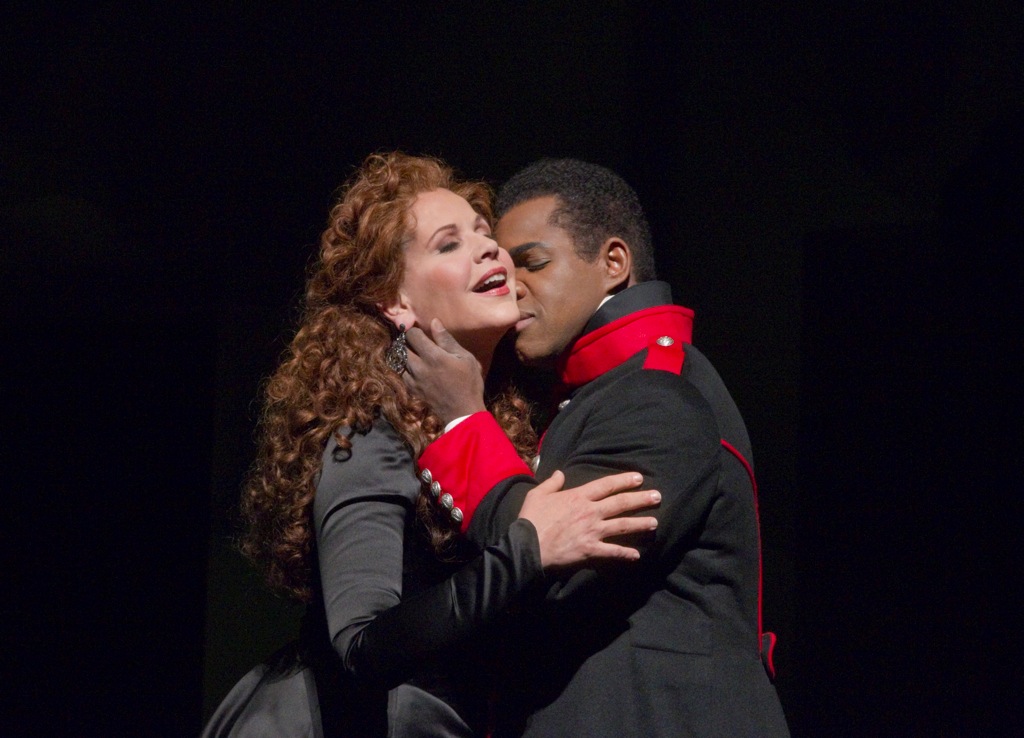
Renée Fleming and Lawrence Brownlee in Armida.
Photo by Ken Howard  © 2010 The Metropolitan Opera
This month sees the first revival of the Met's 2010 production of Armida. Written in 1817, this Rossini rarity is only performed on rare occasions: in this case as a vehicle for soprano Renée Fleming.


Rossini composed Armida for soprano Isabella Colbran a bel canto diva with an agile instrument. In fact, the title role is the most difficult role written by this composer for a female voice. Sadly, he chose a cliche-riddled story that had been set by other composers, including Lully, Vivaldi, Salieri, Gluck, Haydn, and Handel. The story comes from Gerusalemme liberata, an epic poem by the 16th century bard Torquato Tasso.

Armida is a sorceress who tests the loyalties of six knights during the Crusades, complete with a magic castle and garden. (In other words, it's like Parsifal but with more sex and more singing.) The Mary Zimmerman production veered into silliness in the second act, which featured a controversial ballet sequence that outfitted the Met's crack dance corps in horns and tails as the critters within Armida's garden. One wonders if the company's revival will veer to the side of good taste and amputate the ballet.
Devils dance: The ballet from Act II of Armida.Photo by Ken Howard © 2010 The Metropolitan Opera.

Although Ms. Fleming is the unquestioned star of this revival, she is surrounded by a small solar system of tenors, including the redoubtamble Lawrence Brownlee in the role of Rinaldo. John Osborn, Antonio Siragusa, Barry Banks and Kobie van Rensburg are the outlying planets.

Recommended Recordings:
Luckily for Rossini lovers and fans of Ms. Fleming, the diva's 1994 recording of Armida is back in the catalogue. Daniele Gatti conducts. The Met's HD broadcast of the opera from last season--featuring roughly the same cast as the coming revival, and with the silly ballet in place, arrives on DVD on Tuesday.

Finally, fans of the great Maria Callas should investigate a bootleg 1952 recording of Armida which arrives on CD this Tuesday. Although it's in mono and the sound is somewhat dodgy, the set features La Callas at the peak of her powers.

Friday, February 11, 2011

Concert Review: Rebels With A Cause

Beethoven and Shostakovich at the New York Philharmonic
Jonathan Biss, at the Steinway. Photo © 2009 EMI Classics
Friday morning's New York Philharmonic concert featured a pairing of two composers who spent their lives struggling against the systems that spawned them: Beethoven and Shostakovich. Latvian conductor Andris Nelsons led the stylish pairing of the former's Third Piano Concerto, (featuring soloist Jonathan Biss) with the latter's Fifth Symphony.


After the lengthy orchestral introuction, Mr. Biss played the piano solo part with elegance and Mozartean grace. His limpid playing emphasized the melodicism in Beethoven's solo part, contrasting with the thoughtful commentary from the orchestra. This was especially true in the second movement, played with a smooth-flowing legato and a very gentle attack.

The final rondo took the piece to new, playful heights, as Mr. Biss engaged in a game of chase-and-tag with the orchestra, racing higher and higher on the keyboard and then soaring back down in a rush of arpeggiated notes. As the soloist played his final round of repetitions, Mr. Nelsons and his orchestral forces raced to catch up, with band and pianist finishing together in an exuberant outpouring of song.

Shostakovich wrote his Fifth Symphony as a response to Joseph Stalin's series of devastating artistic purges in 1936, that were themselves a response to the dictator's (over)reaction to his opera Lady Macbeth of the Mtsensk District. Shostakovich quietly locked his just-completed Fourth Symphony in a drawer and began working on the Fifth, which he referred to as "A Soviet Artist's Response to Just Criticism."


Politics and history aside, the Fifth has grown to be the most popular of the 15 Shostakovich symphonies, a big-shouldered four-movement bruiser that requires heroic brass playing and a conductor with tight control over the orchestra's balance. This performance had the former, but the strings were repeatedly drowned out by the brass and percussion. Perhaps that was Shostakovich's message: the little guys can't win.

The epic first movement, with its four-note theme in search of a final resolution took the shape as a proletarian struggle between the strings and brass for supremacy. (The strings lost.) The Allegretto, with its marching theme for low basses and plaintive dance for woodwinds seemed to symbolize the composer's private struggles with the censors and the Soviet state.

The Largo is one of Shostakovich's best-known movements, a sweeping theme for winds that builds to a thunder of brass. The trumpets and timpani hijacked the orchestra in the slamming fourth movement, an orchestral showpiece that was performed with an admirable lack of restraint. This was Philharmonic music-making at its most exciting: a big sonic steamroller that flattened everything in its path, including the enthusiastic audience.

Thursday, February 10, 2011

Movie Review: Topsy-Turvy

Jim Broadbent as W. S. Gilbert in Topsy-Turvy. © 1999 USA Films

Mike Leigh's affectionate, (mostly) factual and painstakingly detailed account of the partnership of William Schwenck Gilbert and Sir Arthur Sullivan--and the near dissolution of their partnership before writing The Mikado--might be the greatest backstage opera movie in recent memory. And it's being released on March 29 as part of the Criterion Collecton.

The film is set in 1884. Gilbert & Sullivan were coming off Princess Ida, a box-office bomb. Sullivan, newly knighted, was itching to write "serious" music. Gilbert was working on a new story idea, involving a magic lozenge--which Sullivan wanted nothing to do with. At a creative impasse, Gilbert hit upon the idea of setting an English farce in far-away Japan. The result: The Mikado.

Mr. Leigh's film takes you inside the world of these two creative geniuses, thanks to tour de force performances by Jim Broadbent and Alan Corduner as the librettist and composer, respectively. Mr. Broadbent plays Gilbert as a curmudgeon--the funniest man in England who can amuse the masses but barely cracks a smile. He is an irascible jerk, cold and distant to his wife, and absolute hell on his actors.
Allan Corduner as Sir Arthur Sullivan in Topsy-Turvy. © 1999 USA Films
Mr. Corduner does not pull punches with the portrayal of Sir Arthur. The composer is a drug-addicted mess who goes whoring in Paris and can barely get out of bed to conduct the Ida premiere. But the depravities of both men are redeemed by their respective creative genius, and the sheer alchemy that results when they put their minds together on a project.

And what alchemy it is. The core of Topsy-Turvy is a cracking series of lovingly staged excerpts from The Mikado, The Sorceror and Princess Ida, showcasing the multi-talented cast of singig actors--who all did their own work. Timothy Spall is memorable as Richard Temple, the bass whose booming "Mikado" aria nearly meets Gilbert's snicker-snee. Martin Savage is sufficiently decayed as the opium-addicted George Grossmith who originated the role of Ko-Ko. The supporting cast includes brief (but brilliant turns from Andy Serkis, Dexter Fletcher and

The female leads are strong as well. Shirley Henderson, (Leonora Braham/Yum-Yum) Dorothy Atkinson (Jessie Bond/Pitti-Sing) and Lesley Manville (Mrs. Gilbert) are all appealing. The elegant Eleanor David plays singer Fanny Ronalds: Sullivan's mistress. A scene where she and the composer duet on his song "The Lost Chord" at a recital provides the most sublime moment of the early going, while Ms. Henderson's verion of "The Sun Whose Rays" ends the film on a perfect, wistful note.

Trending on Superconductor

Translate

Share My Blog!

Share |

Critical Thinking in the Cheap Seats