Support independent arts journalism by joining our Patreon! Currently $5/month.

About Superconductor

Our motto: "Critical thinking in the cheap seats." Unbiased, honest classical music and opera opinions, occasional obituaries and classical news reporting, since 2007. All written content © 2019 by Paul J. Pelkonen. For more about Superconductor, visit this link. For advertising rates, click this link. Follow us on Facebook.

Sunday, May 30, 2010

Cosmic Oceans: A Buyer's Guide to Bruckner


Anton Bruckner appears on Austria's 1,000-schilling note.
Start listening to the mighty symphonies of Anton Bruckner and you'll notice two things immediately. One: these are big slow moving works, infused with the composer's rapt religious convictions. They're practically church music. Two, given the massive size of their individual movements, you've now moved into what's considered the "deep end" of 19th century symphonic repertory.
Here's a swimmer's guide to the cosmic oceans of sound: Bruckner's symphonies.
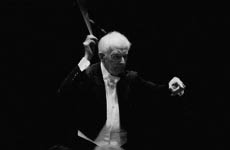
Gunther Wand
The Günter Wand Cycle
This excellent set of the nine numbered symphonies (Wand leaves out the '00' and '0' works) is available in an old-fashioned "doorstop box" from RCA Red Seal. Wand had a long podium career, and became a Bruckner specialist later in his career. His Cologne-based orchestra is quite good, with above-average horns and woodwind. But the selling point here is the conductor's devotion to the absolute letter of Bruckner's scores. This set is a good starting point.

The George Tintner Naxos Cycle
Although he was battling cancer at the time, the late George Tintner made a landmark cycle of Bruckner symphonies. He coaxed great performances from a series of obscure orchestras. This super-budget set includes the, proving that you didn't have to have a big name to play great Bruckner. The set includes Symphony No. 0 (Die Nullte) and the even rarer Symphony No. 00, which Bruckner rejected as being a mere student work.

Royal Concertgebouw Orchestra
cond. by Bernard Haitink; cond. by Riccardo Chailly
Two excellent cycles from the great Dutch orchestra, each featuring a fine conductor. Haitink recorded complete cycles of most of the major symphonists. Under his baton, one hears the classic Concertgebouw sound, a certain mellow orchestral quality that is difficult to duplicate anywhere else. Chailly's set is in more modern digital sound, and showcases this great orchestra under more fiery leadership. His cycle also includes the best performance of "Die Nullte" on this list.
Sergiu Celibidache
Berlin Philharmonic
cond. by Eugen Jochum; cond. by Herbert von Karajan; cond. by Daniel Barenboim
The Berliners cement their reputation as one of the world's top orchestras with these three fine cycles. Jochum is brisk and no-nonsense. His cycle is like Wand's, close to the letter of the text and a sturdy presence in the CD catalogue for years. Karajan is very comfortable in this music and takes a relaxed Romantic approach. These Berlin recordings are better than his later "Karajan Gold" recordings with the Vienna Philharmonic.


The more recent Barenboim recordings (his second complete cycle of the symphonies--the first has been deleted) are the most idiosyncratic, with odd decisions in matters of tempo and dynamic. Still, the Berlin forces play their hearts out, and it is interesting to hear Barenboim puts his unique stamp on each symphony.

The Recordings of Sergiu Celibidache
Special mention must be made of this maverick Romanian conductor. Like Wand, Celibidache was a Bruckner specialist. However, unlike most conductors, Celibidache did not believe in making recordings. Luckily his family preserved tapes of radio broadcasts of some of his performances. These were released after his death in a series of issues on EMI and Deutsches Grammophon. These are not complete cycles, (Symphonies Nos. 1 and 2 are missing, and the DG set omits No. 6 as well) but the performances are moving and in most cases, super-slow. Not the best first performances to own, but these are favorites of Bruckner devotees.

Friday, May 28, 2010

Opera Review: Frozen Ghost

Hamlet at the Washington National Opera.
by Paul J. Pelkonen
Act III of Hamlet as it appeared in the Kansas City production.
The Washington National Opera closed out its 2010 season with a brilliant staging of Hamlet, the French adaptation of Shakespeare's tragedy by composer Ambroise Thomas. Recent years have led to a rediscovery of this opera, with its tour de force aria for Ophélie and powerful, baritone title role.

Thaddeus Strassberger's production (updated from its first appearance at the Kansas City Opera) sets the play behind the Iron Curtain, in a chilly, snow-swept Denmark crushed by the Communist boot. King Hamlet's funeral opens the opera, with rallying proletarians tearing down the royal statue amidst much flag-waving. (The parallel to Baghdad, circa 2003 is an easy one.) The choristers sang from the middle of the house in a rally of support for Claudius and his new administration. There are raised-fist Fascist salutes, onstage violence by police against protestors, and a bitter, detached Hamlet, moodily smoking a cigarette, hiding behind a pair of Ray-Bans.

Wednesday, May 26, 2010

Finding Yourself Through Music II: Alkan

When you search for yourself, you may just find yourself.

Those words are particularly appropriate this morning.

Last night on the way home from the Mets game, I'm on the train platform at Queensboro Plaza. For entertainment, I'm listening to The Barber of Seville and reading the highly entertaining thriller The Book of the Dead, from the writing team of Douglas Preston and Lincoln Child.

Two-thirds of the way through the book, there is a scene where the bad guy is seducing the girl. And for musical accompaniment, he chooses (of all things) the piano music of Charles-Valentin Alkan.


"Ah, yes. That is Alkan, the forgotten musical genius of the nineteenth century. You will never hear a more luxuriant, cerebral, technically challenging artist--never. When his pieces were first played-- a rare event, by the way since few pianists are up to the challenge--people thought them to be diabolically inspired. Even now, Alkan's music inspires strange behavior in listeners. Some think they smell smoke while listening; others find themselves trembling or growing faint.

"This piece is the Grande Sonate, "Les Quatre Âges." The Hamelin recording of course, I've never heard more assured virtuosity or more commanding finger technique." He paused, listening intently for a moment. "This fugal passage, for instance. If you count the octave doublings, it has more parts, than a pianist has fingers! I know you appreciate it…as few do."


Well, let us say that I was stunned. I'm a piano music geek and something of an Alkan fan. I have had that very recording for years. So I wake up today and determined to write about that very recording. Looking for a picture of the composer, I run across this blog post.

"Charles-Valentin Morhange, better known as Alkan (1813-1888), is one of the great, lost piano composers of 19th century France. Great, because his challenging, complex music is written on an epic scale with technical virtuosity that rivals the works of Franz Liszt. Lost, because Alkan was a misanthrope, and quite possibly an agoraphobe. He was also an Orthodox Jew who studied the Talmud and music with equal fervor. The opposite of the flamboyant Liszt, Alkan gave recitals infrequently, taught occasionally, and disappeared for years at a stretch, either travelling abroad or holed up in his Paris apartment, receiving no visitors.

Thanks to a few, brave pianists with fingers and nerves of steel, Alkan's dizzying music is now available to sample on CD. A good place to start is this 1994 recital disc by Marc-Andre Hamelin on Hyperion, featuring the Grande Sonate (Les Quatres Âges) and the Sonatine. The French-Canadian pianist meets the vast technical challenges of this music, but chooses fearsome accuracy over flashy showmanship. This is a performance of extreme dynamics. The artist slams the hammer down at the appropriate climactic moments, but then slows down with an elegant, expansive lyric touch."


Yes, that's right. I wrote those paragraphs about this very recording two years ago, right here on Superconductor. So once again, when you go looking around on the web, you sometimes find…yourself.

Tuesday, May 25, 2010

CD Review: Pavarotti in Idomeneo from 1964

The classic recording from Glyndebourne finally comes to light.
by Paul Pelkonen
EEK! What's that?
In 1964, Luciano Pavarotti was an up-and-coming tenor, just beginning to be heard outside of his native Italy. He was three years into his career when he sang the the role of Idamante at the Glyndebourne Festival. The performances were crucial to exposing the singer to English audiences, not to mention acquainting him with the Mozart opera that he would be associated with later in his career, when he would take on (and record) the more demanding title role.

This recording is the document of those performances. It finds the young Pavarotti in top form. He might be a little raw in spots, but that could also be the fault of the sound quality. The power, range and flexibilty of his instrument are all present, along with that rich, orotund sound that the world fell in love with. Listening to this set, one gets the sense of a young man on his way up, about to conquer the world.


The rest of the cast is incredibly strong. Gundula Janowitz soars as Ilia. She's only 27 here, and the great Karajan recordings were in her future. Like Pavarotti, she was heading for bigger things. Tenor Richard Lewis is strong in the role of Idomeneo, a part which Pavarotti would take on later in his career when his voice had matured a bit. John Pritchard leads a skilful, light-footed performance, conducting from the keyboard.

It should be noted that this recording does not hold up as an ideal first choice for Idomeneo. The performers are using an edited edition of the score which hurts the work's dramatic flow and omits the ballet music. And the live-recorded sound is occasionally thin, as if the microphones were sometimes in the wrong place. However, this is a valuable document and a great performance. It's also a must for Pavarotti fans who want to hear what their hero sounded like when he was just starting out.

Trending on Superconductor

Translate

Share My Blog!

Share |

Critical Thinking in the Cheap Seats